
Journal · Outbound · 18 min · Nov 23, 2026
The Best Outsourced SDR Agencies of 2026, Sorted by What You Rent
Eight outsourced SDR agencies, sorted by what you rent from each one: a full-time rep, part of one, a team for a market, or a system with no seat to manage, with the terms and a sourced price wherever one is published.
By Vesselin Malev, Managing Director, The Demand Department.
The short answer
An outsourced SDR agency fills your calendar with sales meetings without you hiring the rep. What you rent changes from one agency to the next. Some rent you a full-time rep who works only your account. Some rent you part of one. Some sell a team built for a market. And some sell the meetings with no seat to manage at all.
The price follows what you rent. On this list, a part-time rep starts at $4,000 a month, a dedicated rep on a six-month program at $5,250, and a full-time rep you can cancel anytime at $11,950 per four weeks.
So this list sorts the agencies by what you rent.
If you’re short on time, start here:
The best pick for most B2B companies: The Demand Department. You rent a system. Your market gets mapped, every buyer goes through one sequence across cold email and LinkedIn, and people answer every reply until the meeting lands on your calendar. For what’s included, it usually costs less than the other agencies on this list.
A dedicated caller with no long contract: SalesRoads.
A rep you can hire onto your own team later: memoryBlue.
A part-time rep for an early-stage team: Activated Scale.
The full ranking and the prices are below.
We wrote this list, and we’re number one on it. Every agency below, ours included, went through the same five tests, written down before the names, and the reasons for each place are in its entry.
The list at a glance
| # | Agency | You rent | The work | Price (source, month) | Best for |
|---|---|---|---|---|---|
| 1 | The Demand Department | A system that books the meetings, with no seat to manage | Cold email and LinkedIn, with people answering every reply | Monthly retainer, 3-month minimum, quoted by touchpoint tier | B2B companies whose growth lever is volume |
| 2 | SalesRoads | A full-time rep who is never shared with another account | Calls and email | $11,950 per four weeks for one SDR, cancel anytime (SalesRoads, Nov 2026) | Teams that want dedicated callers and no long contract |
| 3 | memoryBlue | Dedicated reps you can hire onto your own team | Phone first, with email and LinkedIn in support | Not published | Tech companies that plan to build an in-house team |
| 4 | Alleyoop | One to three named onshore reps on a six-month program | 2,500 calls and 500 LinkedIn touches a month per rep, plus email | $5,250/mo for one rep (Alleyoop, Nov 2026) | Teams that want a phone-led program at a published price |
| 5 | EBQ | A half-time or full-time US employee, with a manager included | Cold calling and inbound lead follow-up | $5,000/mo half-time or $10,000/mo full-time, on an annual contract (EBQ, Nov 2026) | Tech companies ready to commit for a year |
| 6 | Activated Scale | A part-time US-based SDR for 15 to 20 hours a week | Email, cold calling and LinkedIn, with you onboarding the rep | $4,000/mo plus commission (Activated Scale, Nov 2026) | Startups that want to try a rep before hiring one |
| 7 | Operatix | An SDR team for a software market, in 22 languages | Outbound sales development and inbound lead qualification | Not published | Software vendors selling across regions |
| 8 | demandDrive | Assigned SDRs who work in your CRM | Outbound prospecting and inbound lead follow-up | Not published | Companies that want a long-term program on retainer |
Every price and claim in this article was checked against the agency’s own site or the source named next to it in November 2026. Prices change often, so confirm the number on the call.
How we ranked them
Five tests. Each one is something you can check before you sign.
1. What you rent, in writing. A full-time rep, part of one, a team or a system, and whether the rep works for anyone else.
2. What the work is. Calls, email and LinkedIn, with a number for each per month.
3. What counts as a result. A meeting booked, a meeting held or a qualified opportunity, defined before the first invoice.
4. What you keep. The lists, the playbook, the recordings, and whether you can hire the rep.
5. What it costs, with a source. A published or reported price with the month, the minimum term and the days before the first outreach.
We built our own system around these five tests, and that’s why we’re first. The details are in our entry below.
Four things you can rent
A full-time rep. One person works your account for the whole week. SalesRoads says each of its reps is 100% dedicated and never shared across accounts. You pay for the seat whether the month is good or slow, so ask what the rep is measured on.
Part of a rep. Half-time at EBQ, or 15 to 20 hours a week at Activated Scale. The bill is smaller and so is the volume, which suits a company still testing its pitch.
A team for a market. A group of reps with the languages and the sector experience for one kind of buyer. Operatix covers 22 languages for software vendors, and memoryBlue counts 30+ languages across seven offices.
A system. No rep is assigned to you. The list, the first touch, the follow-ups and the replies are handled as one process, and you’re billed for the volume it runs.
One more thing to ask early is whether you can hire the rep. memoryBlue calls its version audition-to-hire, and Activated Scale charges 18% of the first-year base salary.
1. The Demand Department
The short version: The Demand Department (TDD) maps your entire total addressable market (TAM) and runs every buyer in it through one multi-touch sequence across cold email and LinkedIn, with LinkedIn content posted from the same profiles. People answer every reply, and the meeting lands on your calendar.
What you rent. The whole outbound system, with no rep to recruit, train or manage. The work an SDR would do is all in it: the list, the first touch, the follow-ups and the replies. There’s more on each channel on our cold email and LinkedIn service pages.
The build. In week one, your market gets mapped and scored and the full lead list is delivered. In week two, LinkedIn outreach and content go live. In week three, cold email starts sending.
After the reply. Every reply is read and answered by a person. A yes gets booked. “Send me more info” gets the one thing that answers it, then the ask. “Not now” becomes a dated follow-up in your CRM. A reply on either channel stops the other the same day, so nobody who answered the email gets a LinkedIn message an hour later.
The volume. Engagements are built around how many buyer touchpoints you want each month: 10,000, 50,000 or 100,000. More touchpoints means more LinkedIn profiles running outreach and content, and more email volume.
What you keep. Domains, inboxes, lists, sequences and content transfer to you on request, and the LinkedIn profiles were always yours.
The proof. Across all clients in the last 12 months: $28M in pipeline added, 2,200+ calls booked and $4.5M in client revenue closed, for 100+ B2B companies. Named clients include Hotjar, Blockworks, Milk Road, beehiiv, NP Digital and SingularityNET. We’re an official partner of Instantly and HeyReach, plus lemlist, Apollo, ZeroBounce and FullEnrich.
Pricing. A monthly retainer with a three-month minimum, set by touchpoint tier and quoted on the strategy session. For what’s included, it usually comes in below the other agencies on this list. After the first three months, the next phase is scoped from real numbers: meetings held and deals closed.
Who it’s for. B2B companies with a proven offer and a market big enough that volume is the lever. The system runs on cold email and LinkedIn, and we don’t run cold calling.
Why it’s first. It passes all five tests in writing: you rent a system with no seat to manage, the work is counted in touchpoints across cold email and LinkedIn, results are counted in meetings held and deals closed, the domains, lists and sequences transfer to you, and the price is quoted from your own volumes.
How to start. The 30-minute strategy session ends with a number: how many meetings the system can book for you, channel by channel, from your volumes. Or get 100 leads scored against your ICP in 24 hours, free.
2. SalesRoads
SalesRoads rents you a full-time rep and tells you exactly what the seat costs. One SDR is $11,950 per four weeks. Two are $16,750 and six are $43,150, which takes the per-SDR price down to $7,192. There’s no long-term commitment, and you can cancel anytime (SalesRoads, November 2026).
Each rep is 100% dedicated to your account. Around the rep sit a strategist, a performance coach, an optimization specialist and a research and data team, with a prospect list of 500 records per SDR each month. The work is outbound calling and email prospecting. A team launches in 15 business days from the kickoff call, so calling starts on the 16th.
Where it falls short: it bills every four weeks, which makes 13 bills a year. The pricing page lists email deliverability infrastructure separately and doesn’t say where the reps are located.
Best for: Teams that want dedicated callers and no long contract. Pricing: $11,950 per four weeks for one SDR, cancel anytime. Watch out: Budget for 13 billing periods a year.
3. memoryBlue
memoryBlue has sold outsourced sales development since 2003. It counts 650+ dedicated SDRs, account development reps and account executives, 3,000+ clients served and seven offices, five in the United States plus London and Singapore (memoryBlue, November 2026).
Its reps are dedicated, and you can hire them. It calls this an audition-to-hire model and says the move happens “with no fight over the transfer.” It also places permanent hires from an alumni network of 500+ people. Onboarding takes roughly two weeks before an SDR program starts live outreach. One case, Trend Micro, reports $2.25M in pipeline in three months.
We compare it with other SDR programs in our ranking of outbound agencies.
Where it falls short: it publishes no rate, because the price depends on the service you need, and it gives no conversion fee for hiring a rep.
Best for: Tech companies that plan to build an in-house team. Pricing: Not published. Watch out: Ask for the hire-out terms up front, including when a rep can move and what it costs.
4. Alleyoop
Alleyoop calls itself “an outsourced SDR team,” and it sells that team in three sizes. Lift is $5,250 a month for one rep, with 2,500 calls and 500 LinkedIn touches a month. Grow is $10,000 a month for two reps, and Scale is $14,750 for three. The reps are named, dedicated and onshore, and Alleyoop calls them Playmakers (Alleyoop, November 2026).
Programs run for six months and renew in six-month terms, and Alleyoop says they go live in under 30 days. The reps are graded on meetings held. When you leave, you keep the prospect lists, the sales playbook and the call recordings. Alleyoop counts 18+ years in outbound and 1,600+ companies served (Alleyoop, November 2026).
Where it falls short: six months is the shortest term, the site says onshore without naming where the reps sit, and it doesn’t describe a way to cancel mid-term.
Best for: Teams that want a phone-led program at a published price. Pricing: $5,250/mo for one rep, $10,000 for two, $14,750 for three. Watch out: Ask what happens if you need to stop before month six.
5. EBQ
EBQ sells outsourced sales and marketing to tech companies, and it prices the sales development seat like an employee. A half-time specialist is $5,000 a month and a full-time one is $10,000, with a consultant, a project manager and its tool suite included. The specialists are salaried employees based in the United States (EBQ, November 2026).
Those prices assume a year. EBQ offers “annual contracts that can be paid monthly.” Its sales development team works through “cold calling and inbound lead follow-up” (EBQ, November 2026). One client, MortgageFlex, says over 90% of the meetings EBQ sets turn into product demos.
Where it falls short: the annual contract is the longest stated commitment on this list, and the site doesn’t say whether a specialist works for one client only or how long a program takes to start.
Best for: Tech companies ready to commit for a year. Pricing: $5,000/mo half-time or $10,000/mo full-time, on an annual contract. Watch out: Ask whether your specialist works on any other account.
6. Activated Scale
Activated Scale matches startups with US-based fractional SDRs and account executives. A fractional SDR costs $4,000 a month plus commission and works 15 to 20 hours a week (Activated Scale, November 2026).
It’s built as a trial for a hire. If the rep works out, you can hire them as your employee, and Activated Scale takes 18% of the first-year base salary. Termination fees are $0, and a rematch is free. It says it connects clients with talent in under seven days and counts 200+ customers (Activated Scale, November 2026).
You onboard the rep yourself, and the rep then tests outbound messaging by email, cold calling and LinkedIn.
Where it falls short: you get a person without a management layer, so the playbook and the coaching are on you. The commission rate isn’t on the page, and 15 to 20 hours a week limits the volume.
Best for: Startups that want to try a rep before hiring one. Pricing: $4,000/mo plus commission. Watch out: Ask for the commission terms in writing.
7. Operatix
Operatix describes itself as an “outsourced SDR agency specialized in helping B2B Software vendors generate pipeline & revenue across the globe.” It counts 300+ SDRs, sales coverage in 22 languages and offices in London, California, Texas and Singapore, and it says it has served 800+ software vendors. CrowdStrike, Rubrik and SentinelOne are among the logos on its site (Operatix, November 2026).
Its homepage now carries the line “Two leaders in outsourced sales have come together!” with links to memoryBlue. The two still run separate sites, and Operatix keeps its focus on software.
Its pricing page is an ROI calculator. You enter your revenue targets, and Operatix says it will “suggest the best program for your needs” (Operatix, November 2026).
Where it falls short: no price and no terms are published, and the site doesn’t say whether an SDR is dedicated to one client.
Best for: Software vendors selling across regions. Pricing: Not published. Watch out: Ask whether your SDRs work on other accounts, and in which office they sit.
8. demandDrive
demandDrive has run sales development programs for 15+ years. Its SDR and BDR outsourcing covers outbound prospecting, engagement and inbound lead follow-up. The SDRs and customer success managers are assigned to you, “stay with your account” and work in your CRM (demandDrive, November 2026).
It works on retainer, and it says programs typically launch outreach in two to three weeks and show results within 30 to 90 days. For large enterprises it also offers variable programs with outcome-based pricing. One client, Qorvo, reports $136M in new converted opportunities (demandDrive, November 2026).
Where it falls short: it publishes no prices, term length, minimums or notice periods, and it says its programs are designed for multi-year relationships.
Best for: Companies that want a long-term program on retainer. Pricing: Not published. Watch out: Ask for the minimum term and the notice period before the proposal.
Honorable mentions
CIENCE, Belkins, Callbox and SalesHive sell SDR programs too, and we compare them by model in our ranking of outbound agencies. If you’d rather pay for each meeting than for a seat, see our ranking of pay-per-meeting agencies.
If you want the whole program run for you, lists and copy included, see our ranking of done-for-you lead generation services.
How fast each one starts
The start date belongs in the contract. Here’s when each agency says the first outreach goes out, counted from kickoff.
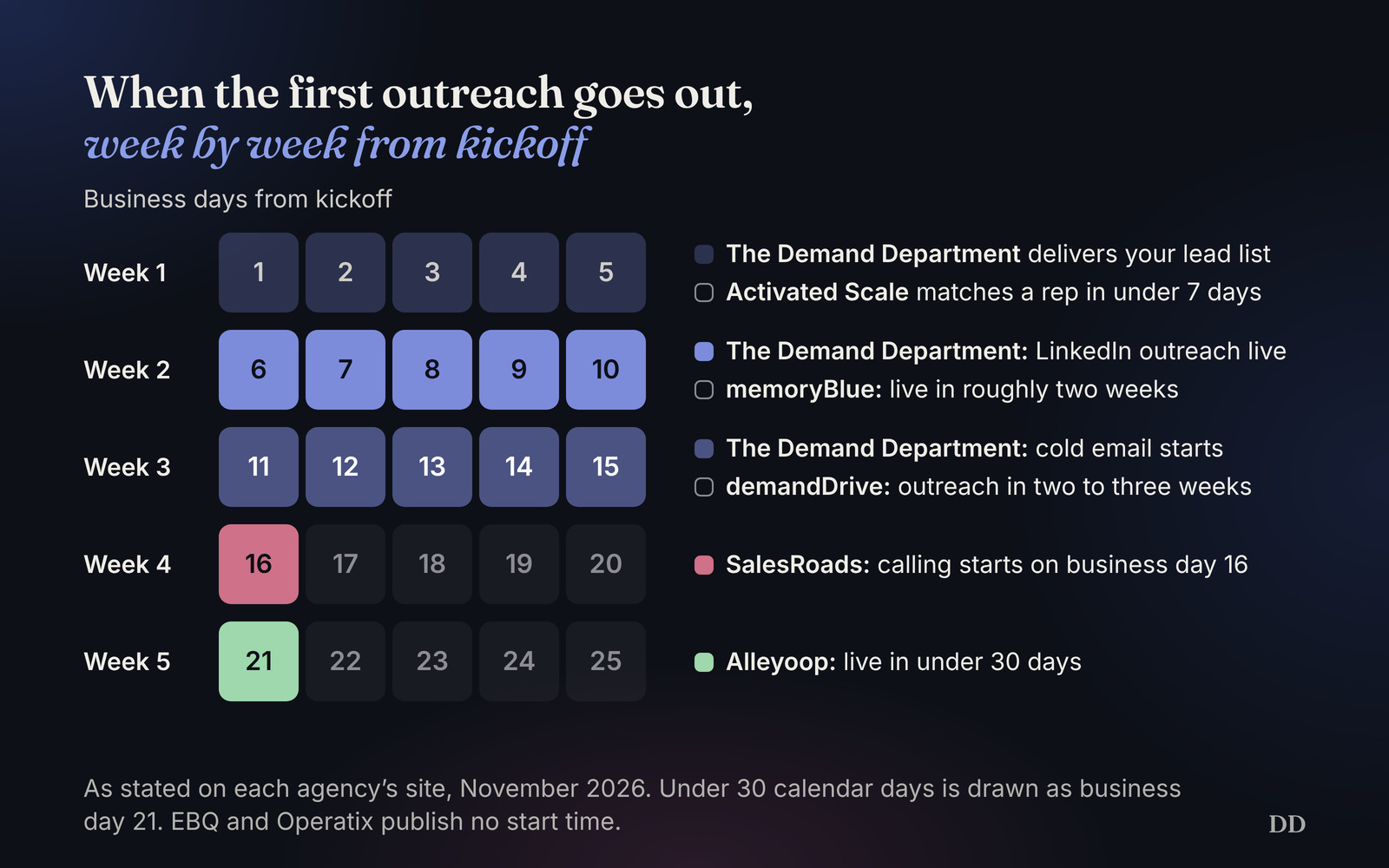
Activated Scale is the quickest to put a person in front of you, with a match in under seven days. Our own build has LinkedIn outreach live in week two and cold email in week three. memoryBlue says roughly two weeks, and demandDrive says two to three. SalesRoads starts calling on business day 16. Alleyoop says it’s live in under 30 days.
EBQ and Operatix don’t publish a start time, so ask for one.
What an outsourced SDR costs in 2026
Four agencies on this list publish a price. Here’s what one rep costs a month at each of them.
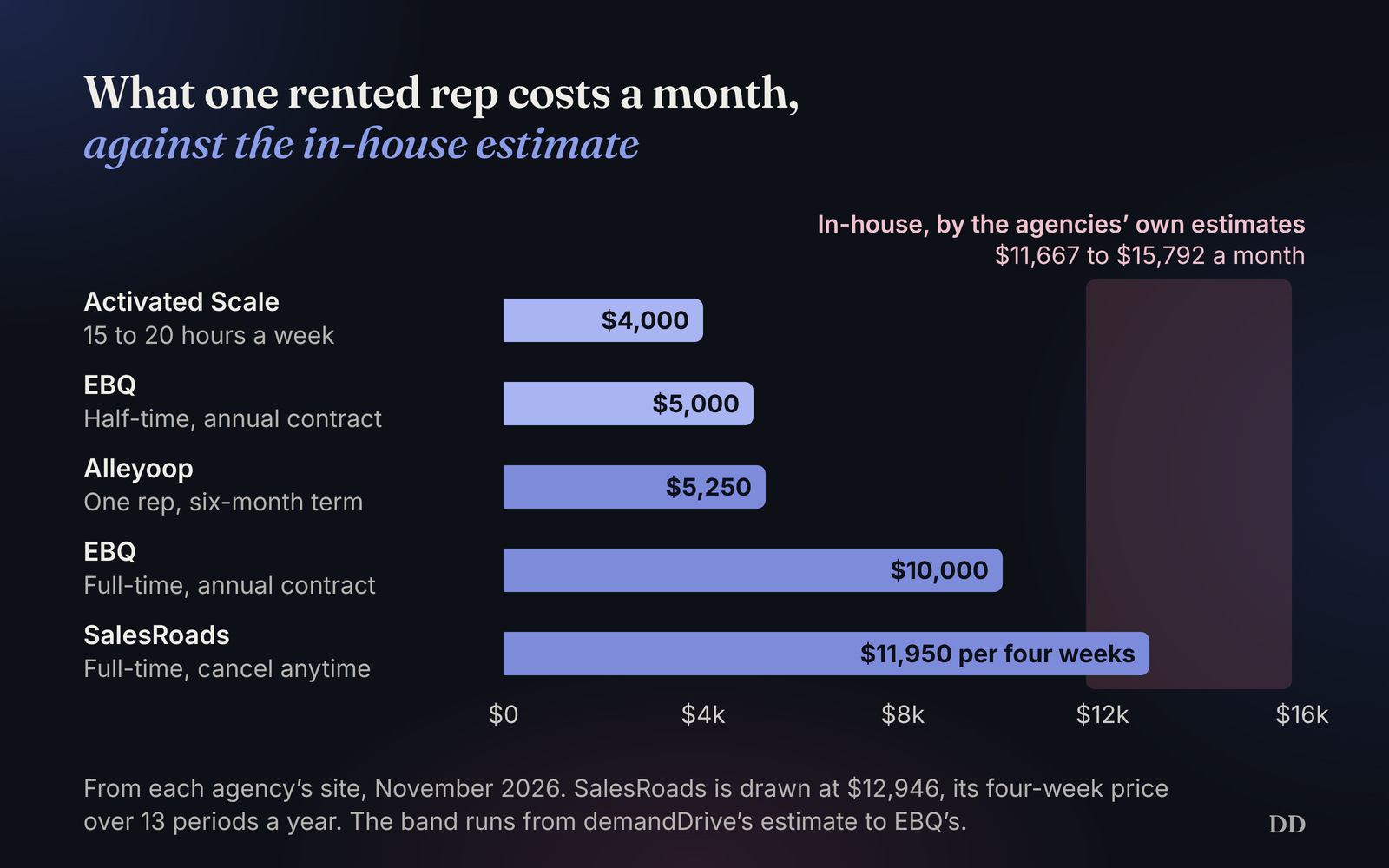
A part-time rep. Activated Scale at $4,000/mo plus commission for 15 to 20 hours a week (Activated Scale, Nov 2026). EBQ at $5,000/mo half-time on an annual contract (EBQ, Nov 2026).
A dedicated rep on a fixed term. Alleyoop at $5,250/mo for one rep on a six-month program (Alleyoop, Nov 2026). EBQ at $10,000/mo full-time on an annual contract (EBQ, Nov 2026).
A dedicated rep you can cancel anytime. SalesRoads at $11,950 per four weeks for one SDR, down to $7,192 per SDR with six (SalesRoads, Nov 2026). With 13 billing periods in a year, that’s about $12,946 a month.
A system. Our own retainer is quoted by touchpoint tier, with cold email and LinkedIn included.
The agencies also publish what they think the in-house version costs. EBQ puts one BDR with a manager, tools, recruiting and benefits at $189,500 a year. demandDrive puts a fully loaded in-house SDR at roughly $140K to $150K or more. Those are the sellers’ own estimates, so check them against your salaries.
For how each pricing model works, see our guide to GTM agency pricing.
How to choose: a decision map
Find your situation, then look at the first pick, and the second if the first says no.
Meetings on your calendar from cold email and LinkedIn, with no rep to manage: The Demand Department.
A dedicated caller you can cancel anytime: SalesRoads.
A rep you plan to hire: memoryBlue, then Activated Scale.
A phone-led program at a published price: Alleyoop.
A US employee on a one-year plan: EBQ.
A part-time rep for an early-stage team: Activated Scale.
Software sold across languages and regions: Operatix.
A long-term program run in your CRM: demandDrive.
Eight questions for the first call
Every agency here will tell you its reps are good. These questions show what you’d be renting.
1. What exactly am I renting? Good: a full-time rep, part of one, a team or a system, named in the contract. Bad: “a flexible resource.”
2. Does my rep work on any other account? Good: no, or a stated share of the week. Bad: “they’re focused on you.”
3. How many calls, emails and LinkedIn touches go out each month? Good: a number for each. Bad: “as many as it takes.”
4. What counts as a result? Good: a meeting that was held, with the qualifying criteria written down. Bad: “an interested prospect.”
5. When does the first outreach go out? Good: a business day or a week number. Bad: “after onboarding.”
6. What’s the minimum term, and how do I stop? Good: two answers, in the contract. Bad: “we rarely see cancellations.”
7. Can I hire the rep, and what does it cost? Good: a fee or a formula. Bad: “we can discuss it later.”
8. What do I keep when I leave? Good: the lists, the playbook, the recordings and the domains. Bad: “the reporting.”
Frequently asked questions
- What is an outsourced SDR agency?
- It’s a company that does sales development for you, so meetings reach your calendar without you hiring the rep. Depending on the agency, you rent a full-time rep, part of one, a team built for a market, or a system with no seat to manage.
- How much does an outsourced SDR cost in 2026?
- On this list, a part-time rep costs $4,000 a month plus commission at Activated Scale and $5,000 at EBQ. A dedicated rep costs $5,250 a month at Alleyoop on a six-month program, $10,000 at EBQ on an annual contract, and $11,950 per four weeks at SalesRoads with no long commitment.
- Is an outsourced SDR cheaper than hiring one?
- The agencies say so, and they publish their math. EBQ puts one in-house BDR with a manager, tools, recruiting and benefits at $189,500 a year, against $120,000 for its full-time specialist. demandDrive puts a fully loaded in-house SDR at roughly $140K to $150K or more. Run the same sum with your own salaries before you decide.
- How long does an outsourced SDR take to start?
- From two to about four weeks on this list. memoryBlue says roughly two weeks, demandDrive says two to three, SalesRoads starts calling on business day 16, and Alleyoop says it’s live in under 30 days. Our own build has LinkedIn outreach live in week two and cold email in week three.
- Can I hire the outsourced SDR onto my own team?
- At some agencies, yes. memoryBlue calls its model audition-to-hire, and Activated Scale lets you hire the rep for 18% of the first-year base salary. Ask every agency for the fee and the earliest date before you sign.
- Do outsourced SDRs make cold calls?
- Most of the agencies on this list are phone-led. SalesRoads runs calls and email, Alleyoop plans 2,500 calls a month for each rep, and EBQ works through cold calling and inbound follow-up. Our own system books its meetings through cold email and LinkedIn.
Ask what you’re renting
Before you sign with any outsourced SDR agency, ask two things. What exactly am I renting? And what happens to the rep, the lists and the playbook when I leave?
If you want to hear ours, the 30-minute strategy session ends with a number: how many meetings the system can book for you, channel by channel, from your volumes. Or start with 100 leads scored against your ICP, free, in 24 hours.
Three layers, run as one revenue system
This article is one piece of the system we build and operate for our clients. See how the three layers are wired together, read the case studies, or start with how it works.
- Cold Email Outbound — sending infrastructure, verified data, and sequences that book qualified calls.
- LinkedIn Outbound + Content — connection sequences and founder led content run from one profile.
- Paid Advertising — account based campaigns and retargeting on the accounts you already work.
Related articles
- The Best Outbound Agencies of 2026, Sorted by the Model You’re Buying — Nine outbound agencies sorted by what you’re billed for: a system, an SDR seat, an appointment program or a build, each with a sourced price.
- The best Instantly agencies of 2026: partner agencies that run cold email for you — The best Instantly agencies of 2026: eight partner agencies that run cold email for you, each with a sourced price, who answers the replies and whose name the workspace is in.
- The best cold email agencies of 2026, ranked by what happens after the reply — The best cold email agencies of 2026, ranked on what happens after a prospect replies: who answers, how fast, where the meeting lands, and what each one costs.
- The Best Clay Agencies of 2026: Who Builds It, Who Runs It and What It Costs — Nine Clay agencies ranked by who runs the build and who answers the replies, with each one’s Clay partner tier and a sourced price.