
Journal · Outbound · 18 min · Nov 18, 2026
The Best Outbound Agencies of 2026, Sorted by the Model You’re Buying
Nine outbound agencies, sorted by what each one actually bills you for: a system, a dedicated SDR, an appointment program or a build, with the channels, the terms and a sourced price for each.
By Vesselin Malev, Managing Director, The Demand Department.
The short answer
An outbound agency finds the buyers who fit you, contacts them by email, LinkedIn or phone, and turns the replies into meetings for your sales team. Retainers typically run $2,000 to $15,000 a month, per Clutch figures cited by lemlist (lemlist, November 2026).
That range is wide because “outbound agency” covers five different products. One agency sells you a system. Another sells you a person on the phone. A third sells a plan sized by appointments, a fourth builds the machine and hands you the keys, and a fifth charges per meeting. The price only makes sense once you know which one you’re looking at.
So this list sorts the agencies by the model you’re buying.
If you’re short on time, start here:
The best pick for most B2B companies: The Demand Department. One system runs cold email and LinkedIn as a single sequence, people answer every reply, and the meeting lands on your calendar. For what’s included, it usually costs less than the other agencies on this list.
Dedicated callers with every price published: SalesRoads.
SDR seats you can add or remove month to month: CIENCE.
Appointments booked, with no-shows chased: Belkins.
The full ranking and the prices are below.
We wrote this list, and we’re number one on it. Every agency below, ours included, went through the same five tests, written down before the names, and the reasons for each place are in its entry.
The list at a glance
| **#** | **Agency** | **Model** | **Channels** | **Price (source, month)** | **Best for** |
|---|---|---|---|---|---|
| 1 | The Demand Department | A system run for you, billed by touchpoint tier | Cold email and LinkedIn in one sequence, with LinkedIn content | Monthly retainer, 3-month minimum, quoted by touchpoint tier | B2B companies whose growth lever is volume |
| 2 | SalesRoads | Dedicated SDRs, billed per four weeks | Phone and email | $11,950 per four weeks for one SDR (SalesRoads, Nov 2026) | Teams that want dedicated callers and no long contract |
| 3 | CIENCE | SDRs billed per seat, plus a base fee and a bonus on held meetings | Email, phone and LinkedIn | From $4,249/mo with one offshore SDR, before setup and bonus (CIENCE, Nov 2026) | Teams that want to add or remove SDRs month to month |
| 4 | Belkins | An appointment-setting program, sized by appointments a year | Cold email and LinkedIn, with calling on larger plans | Quoted, $5,000 to $9,000/mo reported (Oliv, Oct 2026) | Mid-market teams that want appointments booked and no-shows chased |
| 5 | Sopro | A managed campaign, with replies sent to your team | Email and LinkedIn, with display ads and gifting | From around £3,000/mo, no minimum contract (Sopro, Nov 2026) | Teams with salespeople ready to take the replies |
| 6 | Callbox | A campaign pod, one SDR with a team of six | Phone, email, LinkedIn and web retargeting | $7,334/mo estimated for one pod (Callbox, Nov 2026) | Companies selling across regions and languages |
| 7 | SalesHive | One or two dedicated SDRs on a flat monthly fee | Phone and email | Quoted, month to month or annual (SalesHive, Nov 2026) | Teams that want US-based callers on a monthly plan |
| 8 | memoryBlue | Dedicated reps you can hire onto your own team | Phone first, with email and LinkedIn | Not published | Tech companies that plan to build an in-house team |
| 9 | The Kiln | A build, with Clay systems your team runs afterwards | Automated outbound and LinkedIn outreach | $10k+/mo, 3-month minimum (Clay, Nov 2026) | Larger companies with a team to run the system |
Every price and claim in this article was checked against the agency’s own site or the source named next to it in November 2026. Prices change often, so confirm the number on the call.
How we ranked them
Five tests. Each one is something you can check before you sign.
1. The model, in writing. What you’re billed for, whether that’s a seat, a plan, a system or a build, and what’s inside it.
2. Who answers the reply. A person on the agency’s side who qualifies and books, or a handoff to your team.
3. What counts as a result. A written definition, such as a qualified meeting that was held, in place of a booked slot or a lead.
4. What you keep. The domains, inboxes, lists, sequences and data when the engagement ends.
5. What it costs, with a source. A published or reported price, with the month.
We built our own system around these five tests, and that’s why we’re first. The details are in our entry below.
Five things an outbound agency can sell you
The word “outbound” hides the unit you’re paying for. There are five.
A system, run for you. One team maps the market, writes, sends on email and LinkedIn, answers the replies and books the meetings. You’re billed by volume. This is our model, and Sopro runs a version where the replies go to your own team.
A dedicated SDR. A person who calls and emails under your company’s name, managed by the agency. You’re billed per seat. SalesRoads, CIENCE, SalesHive and memoryBlue sell it this way, and a Callbox pod is one SDR with a support team.
An appointment-setting program. A plan sized by the appointments it aims to book in a year. Belkins sells it this way.
A build. Engineers assemble the data and the automation, then your team runs it. The Kiln is the example on this list, and our Clay agencies ranking covers more of them.
A meeting. You pay per meeting and nothing else. We ranked those separately in pay-per-meeting agencies.
Two agencies can quote the same monthly number for two of these, and you’d be buying very different things. So ask for the unit first.
1. The Demand Department
The short version: The Demand Department (TDD) maps your entire total addressable market (TAM) and runs every buyer in it through one multi-touch sequence across cold email and LinkedIn, with LinkedIn content posted from the same profiles. People answer every reply, and the meeting lands on your calendar.
The model. You’re buying a system, billed by the number of buyer touchpoints it runs each month.
The build. In week one, your market gets mapped and scored and the full lead list is delivered. In week two, LinkedIn outreach and content go live. In week three, cold email starts sending.
After the reply. Every reply is read and answered by a person. A yes gets booked. “Send me more info” gets the one thing that answers it, then the ask. “Not now” becomes a dated follow-up in your CRM. A reply on either channel stops the other the same day, so nobody who answered the email gets a LinkedIn message an hour later.
The volume. Engagements are built around how many buyer touchpoints you want each month: 10,000, 50,000 or 100,000. More touchpoints means more LinkedIn profiles running outreach and content, and more email volume.
What you keep. Domains, inboxes, lists, sequences and content transfer to you on request, and the LinkedIn profiles were always yours.
The proof. Across all clients in the last 12 months: $28M in pipeline added, 2,200+ calls booked and $4.5M in client revenue closed, for 100+ B2B companies. Named clients include Hotjar, Blockworks, Milk Road, beehiiv, NP Digital and SingularityNET. We’re an official partner of Instantly and HeyReach, plus lemlist, Apollo, ZeroBounce and FullEnrich.
Pricing. A monthly retainer with a three-month minimum, set by touchpoint tier and quoted on the strategy session. For what’s included, it usually comes in below the other agencies on this list. After the first three months, the next phase is scoped from real numbers: meetings held and deals closed.
Who it’s for. B2B companies with a proven offer and a market big enough that volume is the lever. The system runs on cold email and LinkedIn, and we don’t run cold calling.
Why it’s first. It passes all five tests in writing: a system billed by touchpoint tier, a person on every reply, results counted in meetings held and deals closed, the assets yours on request, and a price quoted from your own volumes.
How to start. The 30-minute strategy session ends with a number: how many meetings the system can book for you, channel by channel, from your volumes. Or get 100 leads scored against your ICP in 24 hours, free.
2. SalesRoads
SalesRoads puts dedicated SDRs on your account, never shared with another client, working the phone and email. Around each SDR sits a client strategist, a performance coach, an optimization specialist and a research and data team, and the SDR gets 500 prospect records a month (SalesRoads, November 2026).
It publishes the whole price list. One SDR costs $11,950 per four weeks, two cost $16,750 and six cost $43,150, which brings the per-SDR price down from $11,950 to $7,192. There’s no long-term commitment and you can cancel anytime. A team launches in 15 business days, with calling starting on the 16th.
Its definition of a result is written down too. An appointment counts once the SDR has confirmed budget, authority, need and timeline and booked a specific time with a calendar invite (SalesRoads, November 2026). One client, AchieveIt, reports 937 appointments and $27M in pipeline.
Where it falls short: it bills every four weeks, which makes 13 bills a year, and its pricing page doesn’t mention LinkedIn or say what you keep at the end.
Best for: Teams that want dedicated callers and no long contract. Pricing: $11,950 per four weeks for one SDR. Watch out: Budget for 13 billing periods a year.
3. CIENCE
CIENCE runs managed SDR teams across email, phone and LinkedIn, with one SDR handling all three so the buyer hears from one person. It says it has served 2,500+ B2B clients in 10+ years, and it names Okta, Microsoft and Uber among the companies it has booked meetings for (CIENCE, November 2026).
The price is published in parts. A campaign team costs a flat $2,000 a month however many SDRs you have, and its graph8 platform costs $499. Each SDR starts at $1,750 a month offshore or $3,500 in the US or Europe. On top sits a bonus per SDR that only pays out from 60% of target, and a one-time setup fee whose amount isn’t listed (CIENCE, November 2026). One offshore SDR therefore starts at $4,249 a month, and CIENCE’s own example of five comes to $11,249.
It’s month to month, you can add or remove SDRs each month, and campaigns go live less than 14 days after setup. It reports held meetings, and the commission applies only to meetings that are held.
Where it falls short: the setup fee isn’t published, and the pages don’t define “held” or “qualified”, so the bonus depends on a definition you’ll need in writing.
Best for: Teams that want to add or remove SDRs month to month. Pricing: From $4,249/mo with one offshore SDR, before setup and bonus. Watch out: Ask for the setup fee and the bonus formula before you compare quotes.
4. Belkins
Belkins sells appointment setting on four plans, each sized by the appointments it targets in a year: 30+ on its small business plan, 100+ on Growth, 200+ on Growth Plus, and a custom Enterprise plan. The small business plan covers cold email and LinkedIn and is delivered through partner agencies. Growth adds intent-based calling, messaging apps and events, and Growth Plus adds cold calling, account-based marketing and paid ads (Belkins, November 2026).
Every plan includes lead research, copywriting, appointment scheduling and no-show recovery. Belkins doesn’t publish prices. Oliv’s roundup puts it at $5,000 to $9,000 a month (Oliv, October 2026).
Where it falls short: Miniloop’s pricing review says minimum terms typically run three to six months, that some packages carry a setup fee of $2,000 to $5,000, and that the warmed domains, sequences and templates usually stay with Belkins when the contract ends (Miniloop, May 2026).
Best for: Mid-market teams that want appointments booked and no-shows chased. Pricing: Quoted, $5,000 to $9,000/mo reported. Watch out: Get domain ownership at exit in writing.
5. Sopro
Sopro runs fully managed outreach by email and LinkedIn, with display ads and gifting as extras, and it builds a fresh audience for each campaign that’s “yours to download and keep.” Pricing starts at around £3,000 a month, there’s no minimum contract, and it says a campaign can be live in three weeks (Sopro, November 2026).
Its public counters show the scale: 91,384,357 outreach messages sent and 630,388 conversations started, which is about one conversation for every 145 messages (Sopro, November 2026).
Where it falls short: the replies go straight to your team. “Sales enquiries go directly to your team,” as its site puts it, so qualifying and booking are your job.
Best for: Teams with salespeople ready to take the replies. Pricing: From around £3,000/mo. Watch out: Decide who on your side answers within the hour before the campaign goes live.
6. Callbox
Callbox sells in campaign pods. Each pod is one SDR with a team of six behind them, built around one market segment or buyer type, and it works phone, email, LinkedIn and web retargeting in several languages. Founded in 2004, it says it has served 15,000+ companies in 60+ countries (Callbox, November 2026).
Its pricing page estimates one pod at $7,334 a month, with the exact price given after a consultation, and you add pods to scale.
Where it falls short: the published number is an estimate, and contract lengths aren’t published.
Best for: Companies selling across regions and languages. Pricing: $7,334/mo estimated for one pod. Watch out: Ask for the contract length and the exact pod price in the same email.
7. SalesHive
SalesHive runs cold calling and cold email with a core SDR team it describes as 100% US-based, and it offers offshore calling teams as a separate option. Its three plans are sized by people and activity: one SDR at 100+ touches a day by phone, one SDR at 250+ by phone and email, or two SDRs at 500+ (SalesHive, November 2026).
The fee is one flat monthly number, quoted on a call. Oliv’s roundup estimates $2,000 to $3,000 a month at entry and $6,000 to $12,000 for full programs (Oliv, October 2026). Plans run month to month or annual, with the annual plan cheaper on a 12-month commitment, and most clients launch about three weeks after kickoff. You owe nothing until you approve the launch.
It counts 106,000+ client meeting bookings since 2016. It says plainly that those are recorded bookings and don’t show attendance, and that it doesn’t guarantee any number of meetings.
Where it falls short: no price is published, and cancelling a monthly plan takes until the end of the next billing month.
Best for: Teams that want US-based callers on a monthly plan. Pricing: Quoted. Watch out: Ask how many booked meetings were held, since its headline number counts bookings.
8. memoryBlue
memoryBlue has sold outsourced sales development since 2003. It counts 650+ dedicated SDRs, account development reps and account executives, 3,000+ clients served and offices from Tysons, Virginia to London and Singapore (memoryBlue, November 2026).
Two things set its model apart. It’s a phone-first shop, with email and LinkedIn in support. And you can hire its reps onto your own team: it calls this an audition-to-hire model. One case, Trend Micro, reports $2.25M in pipeline in three months.
Where it falls short: no price is published. The cost depends on the service, the team size and whether the engagement is outcome-based or a standard retainer, so you can’t compare it before a call.
Best for: Tech companies that plan to build an in-house team. Pricing: Not published. Watch out: Ask for the hire-out terms up front, including when a rep can move and what it costs.
9. The Kiln
The Kiln sells a build. Its engineers assemble Clay systems for TAM mapping, lead enrichment, automated outbound and CRM cleanup, and they work on a few clients at a time (The Kiln, November 2026). One client, Bunker, says the team “recorded detailed SOPs for our team to use after the engagement.”
Clay lists it as an Elite Studio partner at $10k+ a month with a three-month minimum (Clay, November 2026).
Where it falls short: somebody still has to run the system. The Kiln doesn’t publish who answers replies once it’s live, so plan for your own team to do it.
Best for: Larger companies with a team to run the system. Pricing: $10k+/mo, three-month minimum. Watch out: Name the person on your side who’ll own the system before the build starts.
Honorable mentions
Martal Group runs email first, then LinkedIn follow-up, then calls, with 200+ onshore sales executives and pricing on request (Martal Group, November 2026). Leadium runs appointment setting across email, phone, LinkedIn, SMS and gifting (Leadium, November 2026). Operatix sells SDR teams to B2B software vendors in 22 languages and has joined forces with memoryBlue (Operatix, November 2026).
If you’ve already picked a channel, we rank cold email agencies and agencies that run cold email and LinkedIn together on their own pages. For LinkedIn on its own, see our ranking of LinkedIn lead generation agencies.
What a dedicated SDR costs as the team grows
Two agencies on this list publish the whole price list, so you can do the math before a call.
SalesRoads charges per four weeks: $11,950 for one SDR, $16,750 for two, $23,500 for three and $43,150 for six. CIENCE charges per month: a $2,499 base for the campaign team and the platform, then from $3,500 for each SDR in the US or Europe. That’s $5,999 for one SDR and $23,499 for six, before its bonus and setup fee.
Put the two lists side by side and two things stand out. The first SDR is the expensive one on both, because the fixed cost sits on a single seat: SalesRoads falls from $11,950 per SDR to $7,192 at six, and CIENCE falls from $5,999 to $3,917. And where the SDR sits moves the bill. CIENCE’s seat fee is half as much offshore, at $1,750.
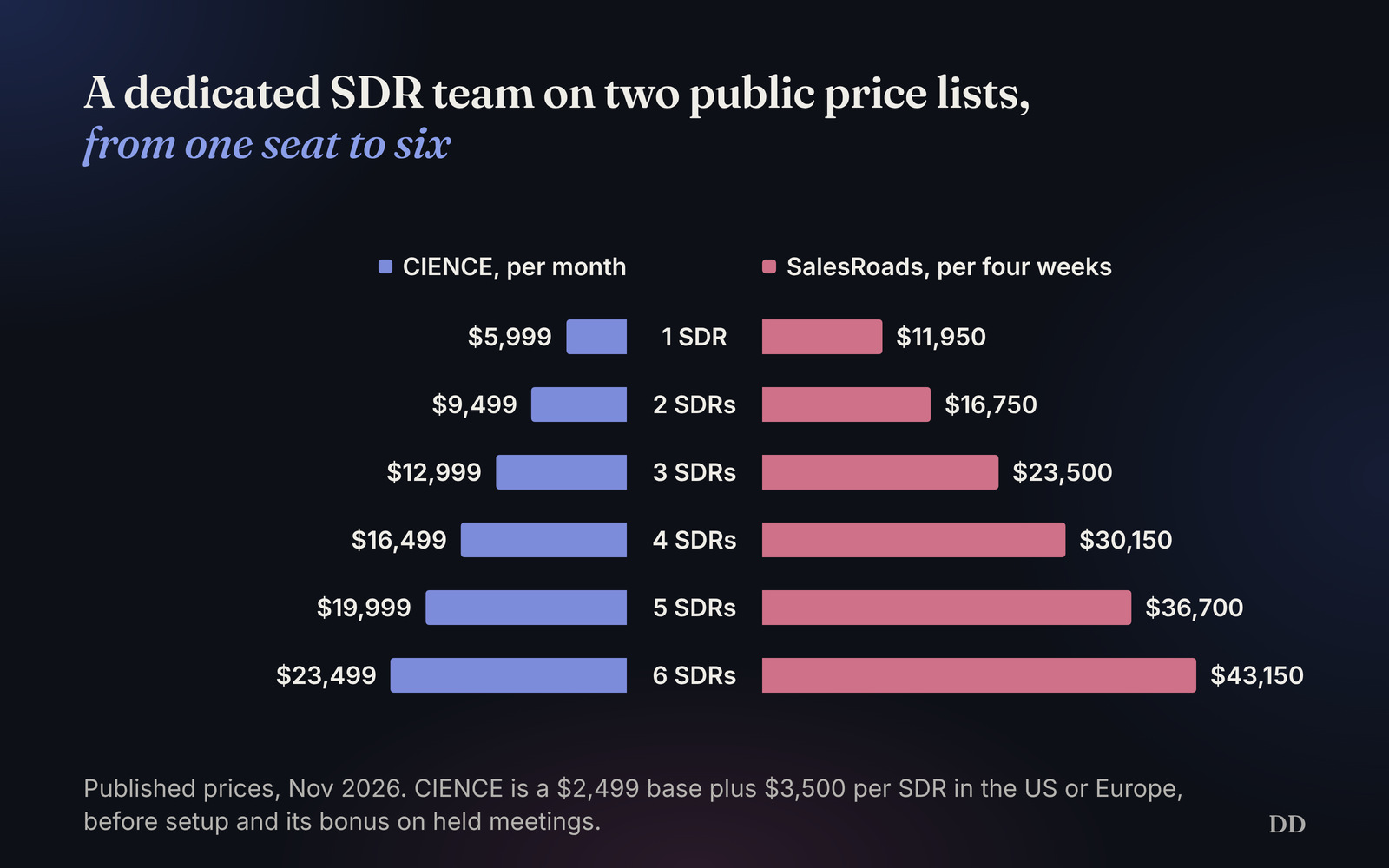
So when an agency quotes you per SDR, ask for the price at one, two and three seats, and ask where those people sit.
Ask for the channel mix in numbers
“Omnichannel” is on almost every agency’s homepage. Very few say how the touches split.
Martal Group does. Its published average monthly funnel is 9,000 to 12,000 emails, 600 to 700 LinkedIn follow-ups and 250 to 450 calls, sent to 3,000 to 5,000 prospects (Martal Group, November 2026). At the midpoint of each range, about nine in ten touches are emails.
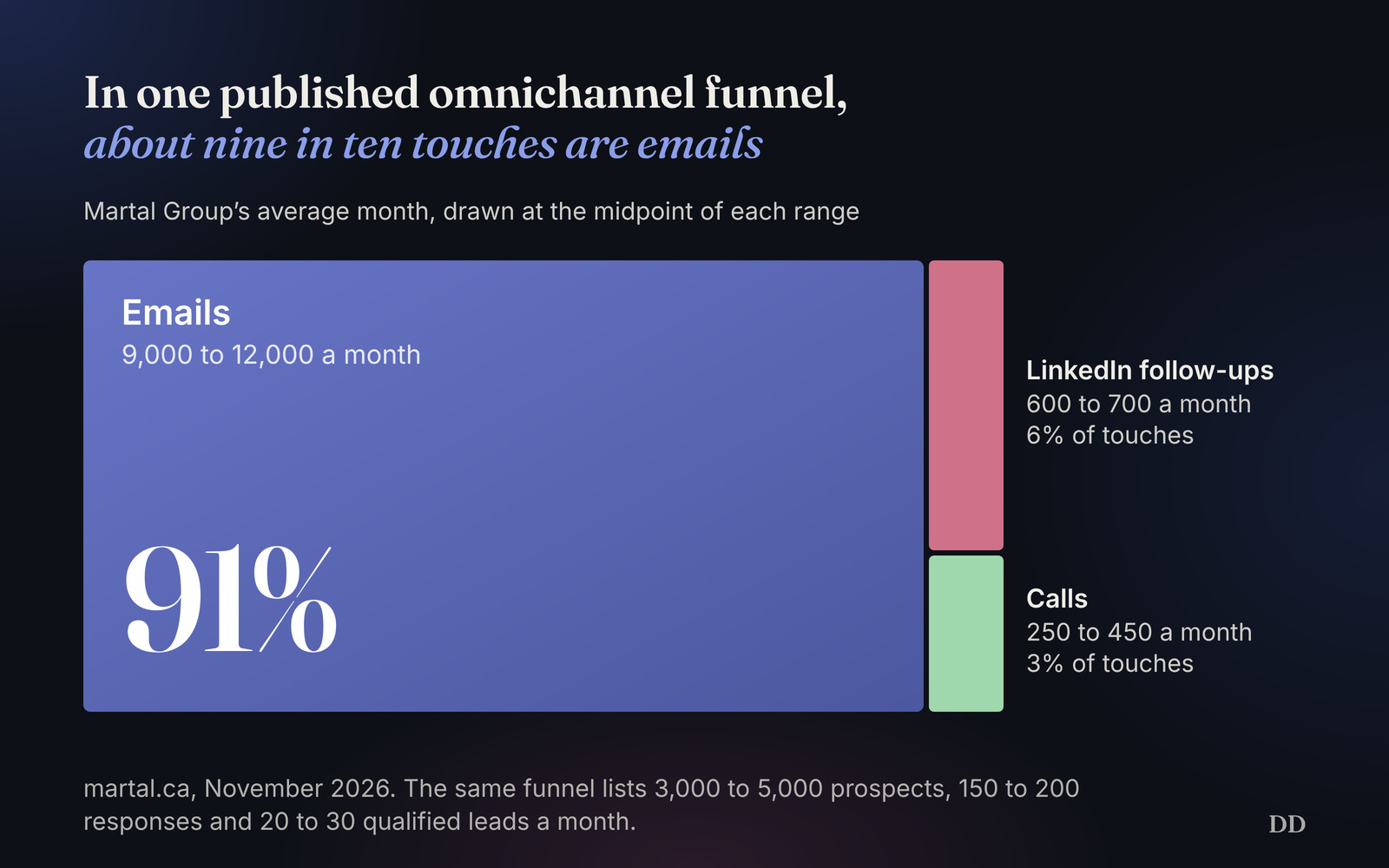
The mix tells you what you’re buying. Here it’s an email program with LinkedIn and calls as follow-up, and the same funnel ends in 150 to 200 responses and 20 to 30 qualified leads a month. A phone-first SDR team would look very different.
So before you compare two quotes, ask each agency for the same three numbers: emails, LinkedIn touches and calls a month.
What outbound agencies cost in 2026
Start with the least you can commit, then the monthly number. Across this list, the price comes in five shapes:
A system on a retainer. Our own retainer is quoted by touchpoint tier, 10,000, 50,000 or 100,000 a month, with a three-month minimum. Sopro starts at around £3,000/mo with no minimum contract (Sopro, Nov 2026).
A dedicated SDR. SalesRoads at $11,950 per four weeks for one SDR, cancel anytime (SalesRoads, Nov 2026). CIENCE from $4,249/mo with one offshore SDR or $5,999 with one in the US or Europe, month to month, before setup and bonus (CIENCE, Nov 2026). Callbox at an estimated $7,334/mo for one pod (Callbox, Nov 2026).
An appointment program. Belkins is quoted, at $5,000 to $9,000/mo reported (Oliv, Oct 2026), with minimum terms of three to six months reported (Miniloop, May 2026).
A build. The Kiln at $10k+/mo with a three-month minimum (Clay, Nov 2026), so the smallest commitment is $30,000 or more.
A meeting. Per-meeting pricing has its own ranking, with the break-even against a retainer, in our guide to pay-per-meeting agencies.
Then ask what sits outside the fee: setup, tools, data and bonuses. For how each pricing model works, see our guide to GTM agency pricing.
How to choose: a decision map
Find your situation, then look at the first pick, and the second if the first says no.
Cold email and LinkedIn run as one sequence, with every reply answered: The Demand Department.
Dedicated callers at a published price, cancel anytime: SalesRoads, then SalesHive.
SDR seats you can add or remove each month: CIENCE.
Appointments booked, confirmed and rescheduled for you: Belkins.
A managed campaign that feeds your own salespeople: Sopro.
Several regions and languages: Callbox, then memoryBlue.
Reps you plan to hire in-house later: memoryBlue.
A system your own team will run: The Kiln.
Eight questions for the first call
Every agency here will tell you it books meetings. These questions show what you’d be paying for.
1. What exactly am I billed for? Good: a unit and a number, per SDR, per plan or per touchpoint tier. Bad: “it’s custom.”
2. Who works on my account each week, and are they shared? Good: named people, dedicated or with the share stated. Bad: “our team.”
3. What’s the channel mix in numbers? Good: emails, LinkedIn touches and calls a month. Bad: “omnichannel.”
4. Who answers a reply, and how fast? Good: a person, the same day, with the meeting booked on my calendar. Bad: “we forward the lead.”
5. What counts as a result? Good: a written definition of a qualified meeting that was held. Bad: “a booked call.”
6. What do I keep if we stop? Good: the domains, inboxes, lists and sequences. Bad: “the leads.”
7. Which costs sit outside the fee? Good: setup, tools, data and bonuses, each priced. Bad: “it depends.”
8. What’s the minimum term and the notice period? Good: two numbers. Bad: “we’re flexible.”
Frequently asked questions
- What does an outbound agency do?
- It finds buyers who fit your company, contacts them by email, LinkedIn or phone, and turns the replies into meetings for your sales team. Agencies differ in what they bill for: a system run for you, a dedicated SDR, an appointment program, a build or a meeting.
- How much does an outbound agency cost in 2026?
- Retainers typically run $2,000 to $15,000 a month, per Clutch figures cited by lemlist. On this list, published prices start at $4,249 a month for one offshore SDR at CIENCE and reach $11,950 per four weeks for one SDR at SalesRoads, with Sopro from around £3,000 a month.
- What’s the difference between an outbound agency and an outsourced SDR?
- An outsourced SDR is one of the things an outbound agency can sell: a person who calls and emails for you, billed per seat. Other agencies sell a system billed by volume, a plan sized by appointments, or a build your team runs afterwards.
- How long before an outbound agency starts outreach?
- Most agencies that publish a date start two to four weeks after kickoff. CIENCE says less than 14 days after setup, SalesRoads starts calling on the 16th business day, and SalesHive and Sopro both say about three weeks.
- Do outbound agencies guarantee meetings?
- Most don’t. SalesHive says plainly that it doesn’t guarantee any number of meetings, and CIENCE ties a bonus to meetings that are held. If you only want to pay for meetings, look at pay-per-meeting agencies, which bill that way.
- Should I hire an outbound agency or build an in-house SDR team?
- An agency gets you live in weeks, while SalesHive puts hiring and ramping an in-house SDR at three to six months. If you want your own team in the end, memoryBlue lets you hire the reps it places with you.
Ask for the unit first
Before you compare two outbound quotes, ask each agency one thing: what exactly am I billed for? Then ask who answers the replies and what you keep. Those three answers tell you more than the monthly number.
If you want to hear ours, the 30-minute strategy session ends with a number: how many meetings the system can book for you, channel by channel, from your volumes. Or start with 100 leads scored against your ICP, free, in 24 hours.
Three layers, run as one revenue system
This article is one piece of the system we build and operate for our clients. See how the three layers are wired together, read the case studies, or start with how it works.
- Cold Email Outbound — sending infrastructure, verified data, and sequences that book qualified calls.
- LinkedIn Outbound + Content — connection sequences and founder led content run from one profile.
- Paid Advertising — account based campaigns and retargeting on the accounts you already work.
Related articles
- The best Instantly agencies of 2026: partner agencies that run cold email for you — The best Instantly agencies of 2026: eight partner agencies that run cold email for you, each with a sourced price, who answers the replies and whose name the workspace is in.
- The best cold email agencies of 2026, ranked by what happens after the reply — The best cold email agencies of 2026, ranked on what happens after a prospect replies: who answers, how fast, where the meeting lands, and what each one costs.
- The Best Clay Agencies of 2026: Who Builds It, Who Runs It and What It Costs — Nine Clay agencies ranked by who runs the build and who answers the replies, with each one’s Clay partner tier and a sourced price.
- The best HeyReach agencies of 2026: who to hire to run LinkedIn outreach on your accounts — Eight HeyReach agencies that run LinkedIn outreach on your accounts, each with a sourced price, whose profiles send and who answers the replies.