
Journal · Outbound · 19 min · Nov 16, 2026
The Best Clay Agencies of 2026: Who Builds It, Who Runs It and What It Costs
Nine agencies that work in Clay, what each one builds, who runs it once it’s built, who answers the replies, and what each one costs, with the source for every price.
By Vesselin Malev, Managing Director, The Demand Department.
The short answer
Clay is where B2B teams build their prospect data. It pulls a company list, finds the right people, runs them through any of 170+ data providers and scores every row, all in one table. Its paid plans start at $167 a month for Launch and $446 for Growth, billed yearly, or $185 and $495 month to month, and more data credits cost more (Clay, November 2026).
A Clay agency builds that table for you. The good ones also decide what happens next: who the list gets sent to, on which channel, and who answers when a buyer writes back.
That’s where Clay agencies split. Some build the system and hand it to your team to run. Others run it for you, all the way to a meeting on your calendar. So this list asks every agency two questions. Who runs it once it’s built? And who answers the reply?
If you’re short on time, start here:
The best pick for most B2B companies: The Demand Department. Clay sits in our data layer next to Apollo and FullEnrich, and we run what it builds as one sequence across cold email and LinkedIn, with people answering every reply and the meeting landing on your calendar. For what’s included, it usually costs less than the other agencies on this list.
An enterprise Clay build for your RevOps team: Go Nimbly.
Clay wired into HubSpot, at a fixed project price: RevPartners.
An Elite Studio partner on a one-month commitment: FullFunnel.
The full ranking and the prices are below.
We wrote this list, and we’re number one on it. Every agency below, ours included, went through the same five tests, written down before the names, and the reasons for each place are in its entry.
The list at a glance
| **#** | **Agency** | **On Clay** | **Who runs it** | **Price (source, month)** | **Best for** |
|---|---|---|---|---|---|
| 1 | The Demand Department | One tool in a data layer with Apollo and FullEnrich, run as one sequence across cold email and LinkedIn | We do, with people answering every reply | Monthly retainer, 3-month minimum, quoted by touchpoint tier | Most B2B companies whose growth lever is volume |
| 2 | The Kiln | Elite Studio partner, Clay-native data systems for inbound, outbound and RevOps, now part of 2X | Built for your team, with services up to automated outbound systems | $10k+/mo, 3-month minimum (Clay directory, Nov 2026) | Larger companies that want enterprise-grade Clay data |
| 3 | Growth Engine X | Elite Studio partner, cold email at volume on Clay-built lists | They send, and positive replies go to your sales team | Not published, free test campaign for buyers who qualify (Salesforge, Sep 2026) | B2B companies with an LTV over $5,000 that want cold email at volume |
| 4 | Go Nimbly | Elite Studio partner, Clay architecture, governance and scoring inside Salesforce or HubSpot | Your RevOps team, after a 3 to 6+ month engagement | $10k+/mo, 3-month minimum (Clay directory, Nov 2026) | Enterprise RevOps teams rolling Clay out across the company |
| 5 | RevPartners | Elite Studio partner and HubSpot Elite partner, now part of Walker Sands | Your team after the build, or theirs on a monthly plan | $25,000 one-time Clay implementation (RevPartners, Nov 2026) | HubSpot companies that want Clay wired into the CRM |
| 6 | Frontal | Elite Studio partner, formerly ColdIQ Agency, Clay-built outbound with ads and content | They do, starting with a 90-day foundation | $5k+/mo, 3-month minimum (Clay directory, Nov 2026) | Funded companies that want Clay outbound, ads and content from one team |
| 7 | FullFunnel | Elite Studio partner, Clay data engine builds and a managed GTM team | Either side, from a build to staffed SDRs | $5k+/mo, 1-month minimum (Clay directory, Nov 2026) | Trying an Elite Studio partner on a short commitment |
| 8 | The GTM Engineering Company | Clay directory partner, builds done for you or with you, plus training | Your team, once it’s trained | $5k+/mo, 3-month minimum (Clay directory, Nov 2026) | Teams that want to learn Clay and own the build |
| 9 | Growth Today | Studio partner, content, outbound and account-based ads on one Clay system | They do, starting with a 90-day pilot | $5k+/mo, 3-month minimum (Clay directory, Nov 2026) | HubSpot teams that want content, outbound and ads together |
Every price and claim in this article was checked against the agency’s own site, Clay’s partner directory or the source named next to it in November 2026. Prices change often, so confirm the number on the call.
How we ranked them
Five tests, all about what happens after the table is built.
1. More than one source behind the list. Clay alone, one data provider, or several, with every email verified before anything sends.
2. Who runs it once it’s built. The agency, or your team after a handoff.
3. Who answers the reply. A person on their side, an AI tag in the inbox, or your own sales team.
4. What you keep. The tables, lists, domains and sequences, and whose account each one sits in when you leave.
5. What it costs, with a source. A published or reported price, with the month.
We built our own system around these five tests, and that’s why we’re first. The details are in our entry below.
What Clay’s partner tiers tell you
Clay runs a Solutions Partner Program for agencies, with four levels. Artisan is for partners whose work gets repeatable results for several clients. Advanced Artisan is for established Clay experts and fractional GTM leaders. Studio is for teams that take on more complex, higher-volume projects, and Elite Studio is for partners working on the hardest problems at the largest enterprises (Clay, November 2026).
Getting in takes an application, a fit review, Clay builds and client testimonials, and a final review. Clay doesn’t publish the criteria for each level. Its directory lists 196 partners (Clay, November 2026).
Partners also earn money from Clay. The program shares 20% of revenue with partners who onboard new customers. That’s worth knowing when an agency recommends a Clay plan for your account.
So a tier tells you Clay reviewed the agency’s work and placed it. What it can’t tell you is who runs the table after the build, or who reads the inbox the morning after a buyer replies. Those are the tests below.
1. The Demand Department
The short version: The Demand Department (TDD) maps your entire total addressable market (TAM) and runs every buyer in it through one multi-touch sequence across cold email and LinkedIn, with LinkedIn content posted from the same profiles. People answer every reply, and the meeting lands on your calendar.
On Clay. Clay is one tool in our data layer, next to Apollo and FullEnrich, both official partnerships, so no single source decides who’s on your list. Every email is verified before it sends, and we’re an official ZeroBounce partner. The list feeds the sequence directly, so nobody on your team has to run a table, export a file or upload a campaign.
The build. In week one, your market gets mapped and scored and the full lead list is delivered. In week two, LinkedIn outreach and content go live. In week three, cold email starts sending.
After the reply. Every reply is read and answered by a person. A yes gets booked. “Send me more info” gets the one thing that answers it, then the ask. “Not now” becomes a dated follow-up in your CRM. A reply on either channel stops the other the same day, so nobody who answered the email gets a LinkedIn message an hour later.
The volume. Engagements are built around how many buyer touchpoints you want each month: 10,000, 50,000 or 100,000. More touchpoints means more email volume and more LinkedIn profiles running outreach and content.
What you keep. Domains, inboxes, lists, sequences and content transfer to you on request, and the LinkedIn profiles were always yours.
The proof. Across all clients in the last 12 months: $28M in pipeline added, 2,200+ calls booked and $4.5M in client revenue closed, for 100+ B2B companies. Named clients include Hotjar, Blockworks, Milk Road, beehiiv, NP Digital and SingularityNET. We’re an official partner of Instantly and HeyReach, plus lemlist, Apollo, ZeroBounce and FullEnrich.
Pricing. A monthly retainer with a three-month minimum, set by touchpoint tier and quoted on the strategy session. For what’s included, it usually comes in below the other agencies on this list. After the first three months, the next phase is scoped from real numbers: meetings held and deals closed.
Who it’s for. B2B companies, agencies, SaaS, fintech and service businesses with a proven offer and a market big enough that volume is the lever. The system runs on cold email and LinkedIn, and we don’t run cold calling.
Why it’s first. It passes all five tests in writing: several data sources behind the list, the system run for you, a person on every reply, the assets yours on request, and a price quoted from your own volumes.
How to start. The 30-minute strategy session ends with a number: how many meetings the system can book for you, channel by channel, from your volumes. Or get 100 leads scored against your ICP in 24 hours, free.
2. The Kiln
The Kiln builds Clay-native data systems for inbound, outbound, marketing and RevOps. Its directory profile lists everything from TAM mapping and deep lead enrichment to CRMs that keep enriching themselves, plus automated outbound systems (Clay, November 2026).
In January 2026, the marketing company 2X bought it. 2X’s announcement calls The Kiln “a leading Clay partner specializing in GTM Engineering Services” and quotes Clay cofounder Varun Anand: “Patrick and Mathias are stars and they’ve built something special with The Kiln” (2X, January 2026). Named clients include Daxko, TwelveLabs and Crescendo.
Clay lists it at Elite Studio, $10k+ a month, with a three-month minimum.
Where it falls short: it’s priced for larger companies, and it doesn’t publish who answers replies once a system is running.
Best for: Larger companies that want enterprise-grade Clay data. Pricing: $10k+/mo, three-month minimum. Watch out: Ask which team runs your account since the 2X deal.
3. Growth Engine X
Growth Engine X sells positive replies from cold email at volume, sent to lists built in Clay. Its site says it sends more than 8 million emails a month, and founder Eric Nowoslawski is a former Clay employee (Salesforge, September 2026). Clay lists it at Elite Studio with a three-month minimum, for B2B companies whose customers are worth more than $5,000 each (Clay, November 2026).
It doesn’t publish a price, but it offers a free test campaign to buyers who qualify before any money changes hands. Its case studies include Instantly, with 10 to 20 positive responses a day over three years.
Where it falls short: replies go to your sales team to work, the site never defines a “positive response,” and no price is published.
Best for: B2B companies with an LTV over $5,000 that want cold email at volume. Pricing: Not published, free test for buyers who qualify. Watch out: Get the definition of a positive response in writing.
4. Go Nimbly
Go Nimbly is a RevOps consultancy that builds Clay into the systems a revenue team already runs: architecture, governance, enrichment and scoring inside Salesforce or HubSpot (Understory, November 2026). It sells four ways in, from Launch to Innovate, depending on how far along your Clay setup is.
Clay lists it at Elite Studio, $10k+ a month, with a three-month minimum (Clay, November 2026). Its packages average three to six months or more, and Intercom and Superhuman appear in its customer stories.
Where it falls short: it’s a build for your RevOps team, so you need people in-house to run it, and it’s priced for enterprise.
Best for: Enterprise RevOps teams rolling Clay out across the company. Pricing: $10k+/mo, three-month minimum. Watch out: Ask who on your team will own the system once the engagement ends.
5. RevPartners
RevPartners connects Clay to HubSpot. Walker Sands bought it in June 2026, and the announcement says it’s the only firm in the world to hold Clay Elite Studio and HubSpot Elite Solutions Partner status at the same time (Walker Sands, June 2026).
It publishes its prices. A Clay implementation is $25,000 one time: a HubSpot and Clay integration plus five playbooks you choose, launched over 90 days. GTM engineering as a service runs $12,900 to $24,000 a month, and RevOps as a service $9,850 to $27,000 a month on a six-month initial term (RevPartners, November 2026).
Where it falls short: the Clay implementation is built around HubSpot, so a Salesforce team gets less from it, and ongoing help starts at $12,900 a month.
Best for: HubSpot companies that want Clay wired into the CRM. Pricing: $25,000 one-time Clay implementation. Watch out: Ask which five playbooks fit your motion before you pick them.
6. Frontal
Frontal is the agency formerly called ColdIQ Agency. In its own words: “In 2026, ColdIQ Agency became Frontal: same operators, same client roster, same Clay partnership, new name” (Salesforge, August 2026). ColdIQ carries on as a media, software and education brand.
Clay lists Frontal at Elite Studio, $5k+ a month, with a three-month minimum. Its services cover GTM engineering, ads and content, and engagements start with “The Foundation,” a 90-day build (Clay, November 2026). Named clients include Okta, Aircall and AirOps (Understory, November 2026).
Where it falls short: ads and content push the total budget up, and it doesn’t publish who answers replies.
Best for: Funded companies that want Clay outbound, ads and content from one team. Pricing: $5k+/mo, three-month minimum. Watch out: Budget for ad spend on top of the fee.
7. FullFunnel
FullFunnel builds Clay data engines and runs managed GTM teams. Its directory profile lists a Clay Enterprise or Pro data engine build, an AI GTM readiness audit and ready-made agents next to the managed team (Clay, November 2026).
It can also staff the work. FullFunnel outsources SDRs and AEs it manages, or recruits a GTM engineer onto your payroll. In its Spara case, a central Clay table fed enriched, scored records into HubSpot (Salesforge, August 2026).
Clay lists it at Elite Studio, $5k+ a month, with a one-month minimum, the shortest commitment of any Elite Studio partner on this list.
Where it falls short: its own site doesn’t publish rates, and with so many ways to buy, scope can drift.
Best for: Trying an Elite Studio partner on a short commitment. Pricing: $5k+/mo, one-month minimum. Watch out: Agree on whether you’re buying a build, a team or a hire before the first invoice.
8. The GTM Engineering Company
The GTM Engineering Company builds GTM systems for venture-backed companies and teaches your team to run them. Its Clay profile lists TAM list building, CRM enrichment and cleanup, build-with-you workshops, build-for-you systems and enablement, at $5k+ a month with a three-month minimum (Clay, November 2026). It says it has built GTM systems for over 100 companies (European Business Magazine, November 2026).
Where it falls short: its profile shows no tier level, and two reviews updated in November 2026 quote different prices for its Starter and Growth tiers.
Best for: Teams that want to learn Clay and own the build. Pricing: $5k+/mo, three-month minimum. Watch out: Get the tier price from the company itself, not a review.
9. Growth Today
Growth Today runs content, outbound and account-based ads from one Clay system, and its engagements start with a 90-day pilot (Understory, November 2026). Its case studies include ActiveCampaign and Ramp.
Clay lists it at Studio, $5k+ a month, with a three-month minimum, and its directory card shows 18 reviews averaging 5.0 (Clay, November 2026). The profile lists inbound lead enrichment, account research and scoring, TAM list building and HubSpot enrichment.
Where it falls short: no published reply process, and ads add spend on top of the fee.
Best for: HubSpot teams that want content, outbound and ads together. Pricing: $5k+/mo, three-month minimum. Watch out: Ask what the pilot has to show by day 90.
Honorable mentions
Workflows.io sits at Studio tier with 19 reviews averaging 5.0 on Clay’s directory, and we cover it in our ranking of Instantly agencies. SalesCaptain is an Advanced Artisan partner, and it’s in our ranking of HeyReach agencies. AY Automate and Understory both publish their own Clay agency rankings with themselves at the top, so read them the way you’d read ours.
Build it for you, or run it for you?
Every Clay agency on this list does one of two jobs, and some do both.
Build it for you. The agency builds the tables, the enrichment and the scoring, connects them to your CRM, and hands the system to your team. The Kiln, Go Nimbly, RevPartners and The GTM Engineering Company work this way. You need someone in-house to run it every day.
Run it for you. The agency builds the data and then does something with it: sends the emails, runs the LinkedIn outreach, answers the replies. We work this way, and so do Growth Engine X, Frontal and Growth Today, each with a different idea of where their job ends.
The first is the right buy if you already have SDRs who need better data. The second is the right buy if what you need is meetings. A Clay table on its own books nothing.
So ask one thing before you look at any price. When the build is done, whose job is it to send the first email?
Why the list needs more than one source
Clay’s real trick is the waterfall. It asks one data provider for an email, and if that provider comes back empty, it asks the next one, and the next, until one finds it.
One test shows the shape. A tester ran the same 350 B2B prospects through four setups and counted only emails that passed verification. Apollo alone found 61%. Adding People Data Labs took it to 72%, Hunter to 79% and Snov.io to 83% (DEV Community, July 2026).
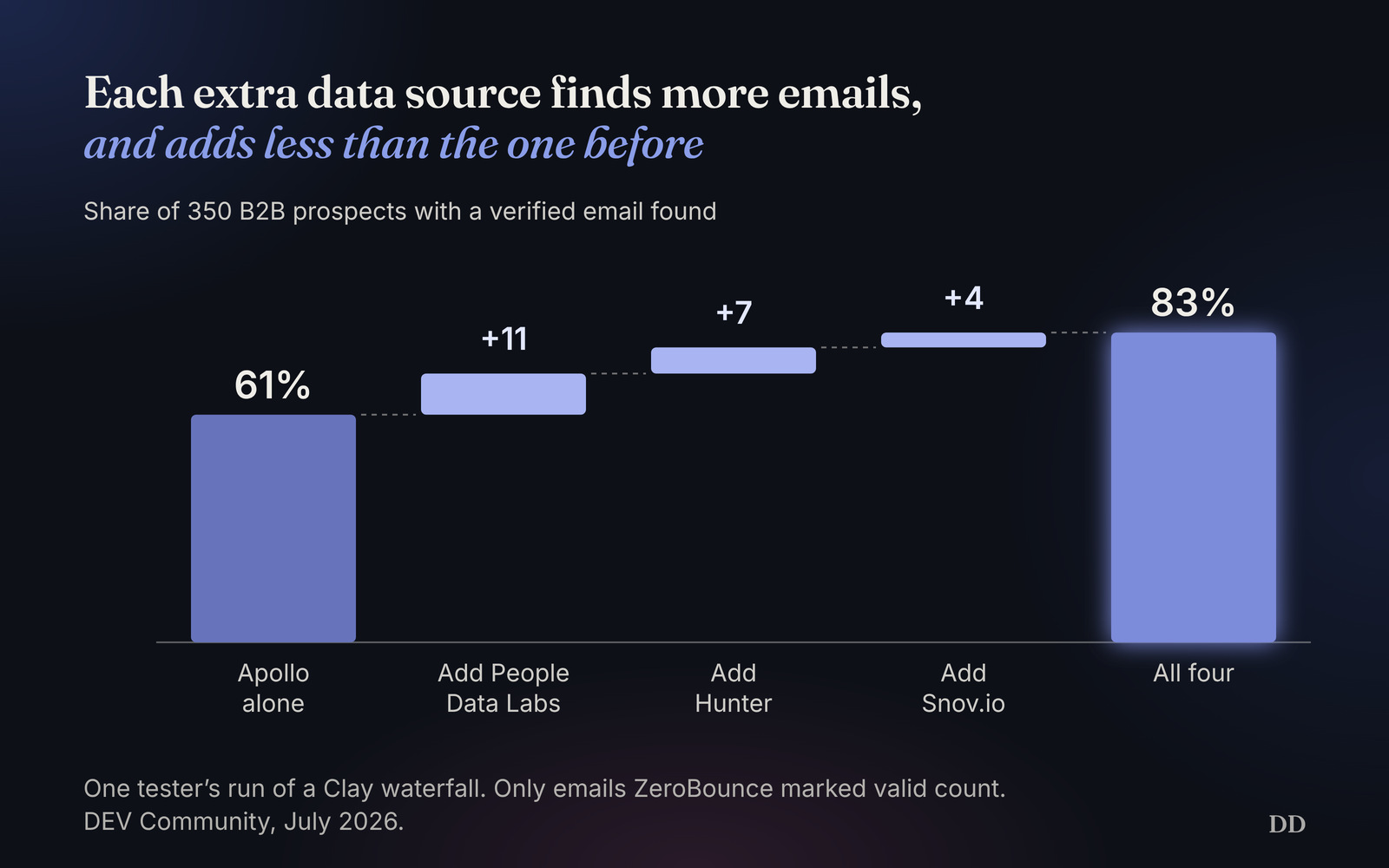
Each extra source found fewer new emails than the one before. On a small test send, the bounce rate also climbed, from 8.3% with Apollo alone to 13.8% with all four. More sources find more people, and the later finds need checking before they go out.
That’s the work you’re paying a Clay agency for: picking the sources, setting the order, and verifying what comes back before it touches your domains. Ask every agency which providers sit in its waterfall, and what it does with an email the verifier calls risky.
What a Clay agency costs in 2026
Three bills sit under every Clay agency: the agency’s fee, the Clay plan, and the data providers the waterfall calls.
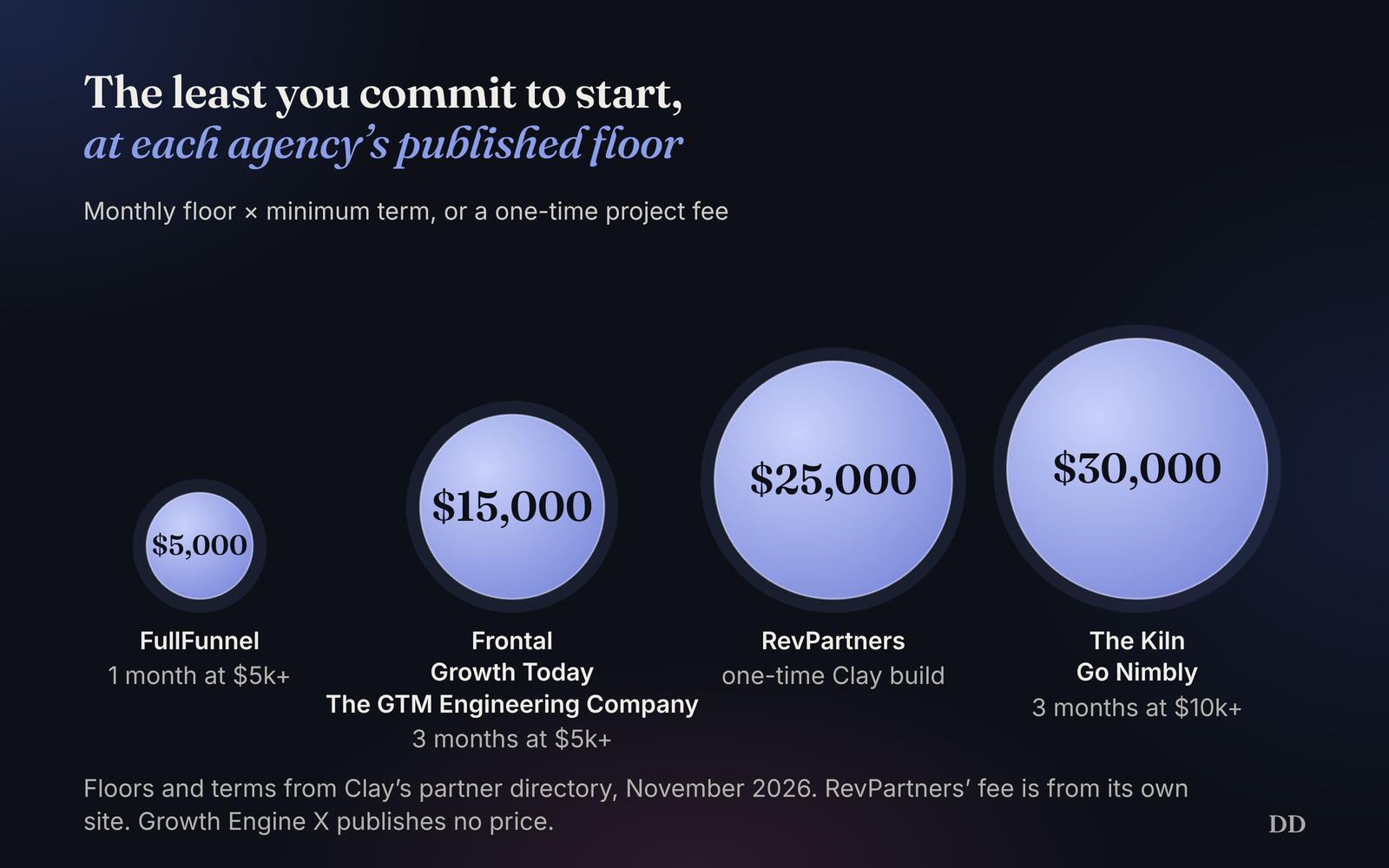
Start with the least you commit. Clay’s directory shows a monthly floor and a minimum term for most partners, and multiplying the two gives the smallest first bill. FullFunnel starts at $5,000 or more for one month. Frontal, Growth Today and The GTM Engineering Company start at $15,000 or more for three months. RevPartners’ Clay implementation is $25,000 one time, and The Kiln and Go Nimbly start at $30,000 or more for three months.
Then add the tools. Clay’s own plans start at $167 a month for Launch and $446 for Growth, billed yearly (Clay, November 2026), and AY Automate’s October 2026 ranking notes that Clay credits and data providers are billed on top of agency fees (AY Automate). DevCommX puts enrichment providers alone at $1,000 to $3,000 a month (DevCommX, August 2026).
Across this list, the price comes in four shapes:
A monthly retainer from $5k+. Frontal, FullFunnel, Growth Today and The GTM Engineering Company (Clay directory, Nov 2026). Our own retainer is quoted by touchpoint tier.
A monthly retainer from $10k+. The Kiln and Go Nimbly (Clay directory, Nov 2026).
A fixed project. RevPartners at $25,000 for a Clay implementation, or $12,900 to $24,000 a month for GTM engineering as a service (RevPartners, Nov 2026). DevCommX puts one-off builds across the market at $15,000 to $50,000 (Aug 2026).
A free test, then a quote. Growth Engine X (Salesforge, Sep 2026).
So ask what’s inside the fee: the Clay plan, the credits, the data providers and the sending tools, and whose name each account is in.
How to choose: a decision map
Find your situation, then look at the first pick, and the second if the first says no.
Meetings from Clay-built data, run for you across cold email and LinkedIn: The Demand Department.
Cold email at volume, with a free test first: Growth Engine X.
An enterprise Clay build for your RevOps team: Go Nimbly, then The Kiln.
Clay wired into HubSpot at a fixed price: RevPartners, then Growth Today.
Clay outbound plus ads and content from one team: Frontal, then Growth Today.
An Elite Studio partner on a short commitment: FullFunnel.
Learning Clay so your own team can run it: The GTM Engineering Company, then FullFunnel.
Eight questions for the first call
Every agency here will tell you it’s great at Clay. These questions show what that means for you.
1. When the build is done, who sends the first email? Good: a named person, on a named date. Bad: “your team will be fully enabled.”
2. Which data providers sit in the waterfall, and in what order? Good: a list of names. Bad: “we use 100+ sources.”
3. What happens to an email the verifier calls risky? Good: it’s held back or checked again. Bad: “we send it and watch the bounces.”
4. Whose Clay account is the table in? Good: mine, or yours with a written transfer at exit. Bad: “we’ll share access.”
5. Who answers a reply, and how fast? Good: a named role, the same day. Bad: “replies go to your reps.”
6. Which costs sit outside the fee? Good: the Clay plan, credits, data providers and sending tools, each priced. Bad: “it depends on usage.”
7. Which Clay plan will you put me on, and why? Good: a plan and a monthly credit estimate. Bad: “the bigger one, to be safe.”
8. What’s the minimum term and the notice period? Good: two numbers. Bad: “we’re flexible.”
Frequently asked questions
- What is a Clay agency?
- An agency that builds prospect data in Clay, a tool that pulls company and contact lists, runs them through many data providers and scores every row in one table. Some Clay agencies hand that system to your team. Others run outbound on it for you, up to the meeting.
- What does Clay Elite Studio mean?
- It’s the top of four levels in Clay’s Solutions Partner Program, above Studio, Advanced Artisan and Artisan. Clay places partners after an application, a review of their Clay builds and client testimonials, and it doesn’t publish the criteria for each level.
- How much does a Clay agency cost in 2026?
- Directory floors on this list run from $5k+ to $10k+ a month, mostly with a three-month minimum. RevPartners charges $25,000 one time for a Clay implementation. Clay’s own plan, from $167 a month for Launch billed yearly, and the data providers usually sit on top.
- Do I need a Clay agency or a GTM engineer?
- If you have SDRs who need better data every day, a GTM engineer or a build-for-you agency fits. If you need meetings and nobody in-house to run the system, hire an agency that runs it for you, up to the calendar.
- Is a waterfall better than one data provider?
- Usually. In one test of 350 prospects, Apollo alone found verified emails for 61%, and four providers in a Clay waterfall found 83%. Each extra provider added less than the one before, and the bounce rate on a test send rose, so every find still needs verifying.
- Can I run Clay myself instead?
- Yes. Clay’s Launch plan starts at $167 a month, billed yearly. The hard part is the rest: choosing data providers, keeping the table clean, writing the outreach, protecting your domains and answering replies every day. If someone on your team has that time, run it yourself.
Ask who runs it after the build
Before you sign with any Clay agency, ask two things. When the build is done, who sends the first email? And what happened to the last ten positive replies it got for a client: who answered, how fast, and how many became meetings?
If you want to hear ours, the 30-minute strategy session ends with a number: how many meetings the system can book for you, channel by channel, from your volumes. Or start with 100 leads scored against your ICP, free, in 24 hours.
Three layers, run as one revenue system
This article is one piece of the system we build and operate for our clients. See how the three layers are wired together, read the case studies, or start with how it works.
- Cold Email Outbound — sending infrastructure, verified data, and sequences that book qualified calls.
- LinkedIn Outbound + Content — connection sequences and founder led content run from one profile.
- Paid Advertising — account based campaigns and retargeting on the accounts you already work.
Related articles
- The best cold email and LinkedIn outreach agencies of 2026: who runs both as one sequence — The best cold email and LinkedIn outreach agencies of 2026, ranked on whether both channels run as one sequence, with prices, terms and best fit for each.
- The best HeyReach agencies of 2026: who to hire to run LinkedIn outreach on your accounts — Eight HeyReach agencies that run LinkedIn outreach on your accounts, each with a sourced price, whose profiles send and who answers the replies.
- The best Instantly agencies of 2026: partner agencies that run cold email for you — The best Instantly agencies of 2026: eight partner agencies that run cold email for you, each with a sourced price, who answers the replies and whose name the workspace is in.
- The best cold email agencies of 2026, ranked by what happens after the reply — The best cold email agencies of 2026, ranked on what happens after a prospect replies: who answers, how fast, where the meeting lands, and what each one costs.