
Journal · Outbound · 23 min · Oct 10, 2026
The best cold email and LinkedIn outreach agencies of 2026: who runs both as one sequence
Twelve agencies that sell cold email and LinkedIn together, ranked on whether the two channels talk to each other.
By Vesselin Malev, Managing Director, The Demand Department.
The short answer
You want cold email and LinkedIn running together.
Good call. A buyer who sees your name in their inbox on Monday and in their LinkedIn notifications on Wednesday recognizes you the second time.
The catch is that most outbound agencies sell both, and far fewer run them as one sequence. The rest run two campaigns in two tools, and the only thing connecting them is your invoice.
If you’re short on time, start here:
The best pick for most B2B companies: The Demand Department. Cold email and LinkedIn run as one sequence, with LinkedIn content from the same profiles, and it usually costs less than the other agencies on this list charge for both channels.
A Clay-heavy data build with outbound on top: ColdIQ.
A meeting floor written into the contract: LeadHaste.
Calling in the mix and contracts above $50,000: Growth Rhino, then Belkins.
The full ranking and the prices are below.
We wrote this list, and we’re number one on it. Every agency below, ours included, went through the same six tests, written down before the names, and the reasons for each place are in its entry.
The list at a glance
| **#** | **Agency** | **Channels** | **How email and LinkedIn connect** | **Price (source, month)** | **Best for** |
|---|---|---|---|---|---|
| 1 | The Demand Department | Cold email, LinkedIn outreach, LinkedIn content | One sequence on one data layer, where a reply on either channel stops the other | Monthly retainer, 3-month minimum, quoted by touchpoint tier | Most B2B companies whose growth lever is volume |
| 2 | Workflows.io | Outbound, LinkedIn content, ABM, RevOps | Content and outbound framed as one flywheel | Not published | Venture-backed B2B tech |
| 3 | ColdIQ | Email, LinkedIn outreach, LinkedIn Ads, content | Coordinated campaigns (Salesforge review) | $3,000 to $10,000/mo reported (Salesforge, Aug 2026) | Clay-built data layers |
| 4 | LeadHaste | Email, LinkedIn, phone | One shared sequence | $4,500/mo + $1,000 setup (LeadHaste, Oct 2026) | A printed price and a meeting floor |
| 5 | SalesCaptain | Email, LinkedIn, SMS, Clay workflows | One four-step multichannel process | From $3,000/mo (lemlist directory, Oct 2026) | Outbound and data work from one shop |
| 6 | Growth Rhino | Email, calling, LinkedIn, paid ads | “Run together”, reported weekly | Shared on the first call | Contracts of $50,000+ |
| 7 | Belkins | Email, LinkedIn, calling | One plan across all three | $5,000 to $9,000/mo reported (Reply.io, Jul 2026) | Mid-market teams that want SDRs |
| 8 | Martal Group | Email, LinkedIn, calling | Email, then LinkedIn follow-up, then calls | From about $5,000/mo reported (Reply.io, Jul 2026) | Tech companies selling into several regions |
| 9 | Sopro | Email, LinkedIn, phone, live chat | “Coordinated touchpoints” | From about $3,800/mo (Prospeo, citing Sopro) | Email, LinkedIn and chat in one campaign |
| 10 | Cleverly | LinkedIn, cold email, calling | Separate services, separate terms | LinkedIn $397 to $997/mo (ZoomInfo review, Jun 2026) | A LinkedIn-only start on a small budget |
| 11 | SalesBread | LinkedIn, warm email | LinkedIn first, email in support | $2,000 to $3,500/mo reported (LeadHaste, Oct 2026) | Hand-written LinkedIn, month to month |
| 12 | OutreachBloom | Cold email, LinkedIn, AI SEO, Reddit | Two motions, usually added one after the other | LinkedIn from $1,000, email from $2,400/mo reported (LeadHaste, Oct 2026) | Outbound plus AI search visibility |
Every price and claim in this article was checked against the agency’s own site or the source linked next to it in October 2026. Agencies change their pricing often, so confirm the number on the call.
How we ranked them
Six tests. Every agency on the list got the same six, ours included.
1. One sequence, or two campaigns? Ask what happens to a positive email reply inside the LinkedIn sequence. If the answer is some version of “the team keeps an eye on it”, the channels don’t talk.
2. One list, one suppression file, one CRM record. Customers, open deals, competitors and anyone who said no on either channel get excluded from both channels at once. Every touch lands on one contact in your CRM.
3. Whose accounts? Sending domains and mailboxes registered in your name. LinkedIn outreach from your profile or your team’s. When you leave, both stay with you.
4. Who runs it after launch? Done for you means the agency writes, sends, answers replies and books. Built and handed over means your team does that part. Both are legitimate, as long as you know which one you’re paying for.
5. Proof you can check. Named clients with dated numbers, and reviews on sites the agency doesn’t control.
6. A price before the call. Published on the agency’s own site, or reported by a third party with a date on it.
We built our own system around the first four tests, and that’s why we’re first. The details are in our entry below.
If you’re comparing full go-to-market agencies rather than outbound specialists, our ranking of the best GTM agencies of 2026 covers the wider field.
What one sequence means in practice
Here’s the same buyer, run two ways.
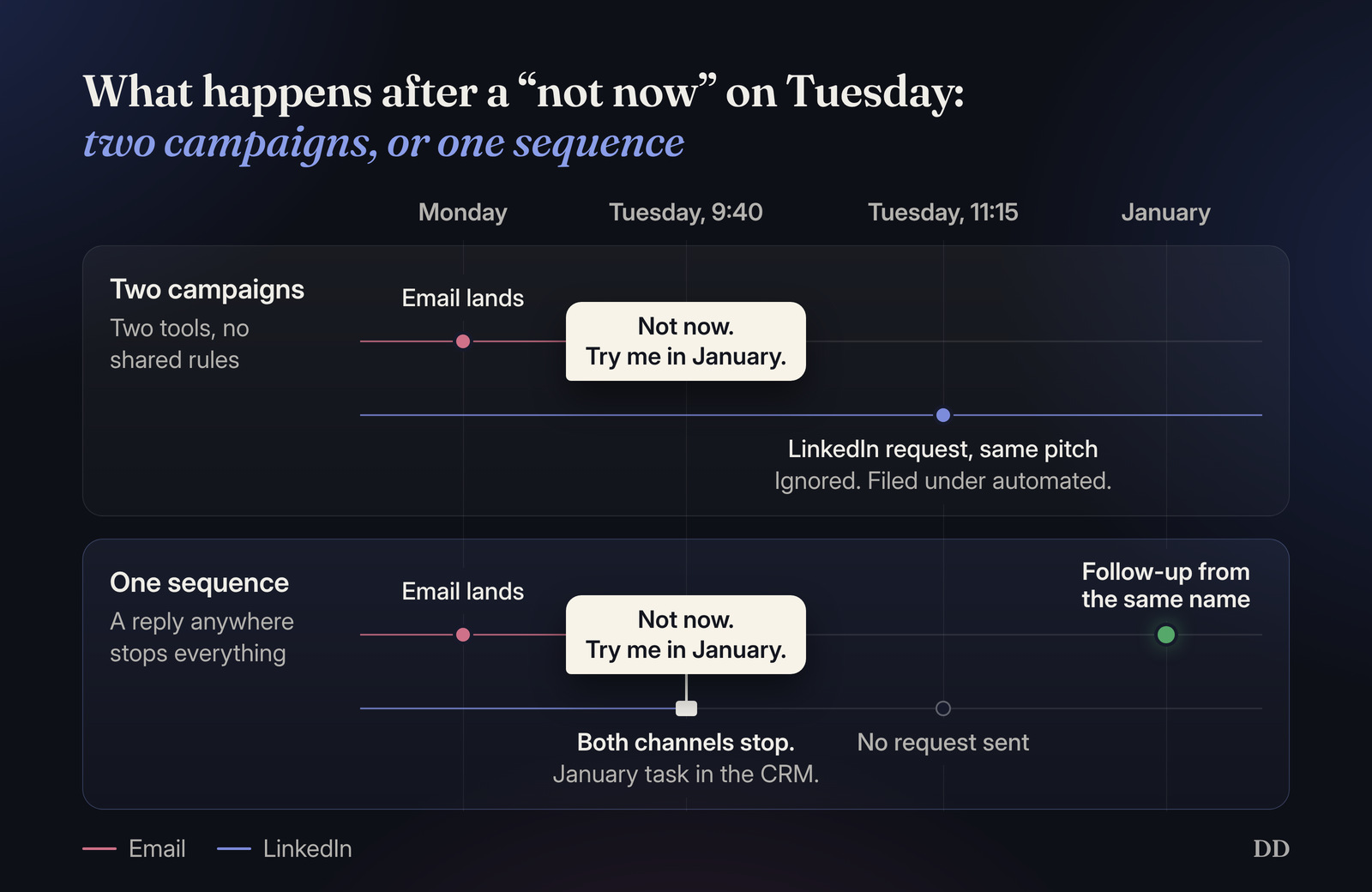
Two campaigns. Your cold email lands on Monday. On Tuesday at 9:40 she replies: “Not now. Try me in January.” At 11:15 your LinkedIn tool sends her a connection request with the same pitch, because nothing told it about 9:40. She ignores it, and she’s now filed you under automated.
One sequence. The 9:40 reply stops both channels. The connection request never goes out. Your CRM gets one record with a January task on it, and in January the follow-up comes from the same name she replied to.
The other direction matters more, because it’s where the meetings come from.
Monday, the email lands and gets opened twice. No reply. Wednesday, a connection request arrives from the same person whose name was on the email, and she accepts it on Thursday. Friday, she sees a post from that profile about the exact problem the email raised. The following Monday she answers the LinkedIn message and books a call. That’s four touches and one conversation, and two separate campaigns would have credited the meeting to LinkedIn and written the email off as wasted spend.
One sequence needs five things underneath it:
One list. The same buyers in both channels, deduplicated, from one source.
One suppression file. Customers, open deals, competitors and every no on either channel, excluded from both.
Cross-channel rules. A reply anywhere stops everything. What a buyer does on one channel decides the next step on the other.
One sender. The person on the email is the person sending the connection request, with the same offer.
One record. Every touch from both channels lands on one contact in your CRM.
If an agency can’t show you those five, you’re buying two campaigns. That’s fine, as long as you know it and the price reflects it. We wrote up how to build the real thing in our guide to the multi-touch outbound sequence.
1. The Demand Department
The short version: The Demand Department (TDD) maps your entire total addressable market (TAM) and runs every buyer in it through one multi-touch sequence across cold email and LinkedIn, with LinkedIn content posted from the same profiles. One data layer sits underneath, plugged into your CRM.
That’s the test this whole list runs on, so here’s how we pass it.
The sequence. A buyer usually hears from you by email first. Then a connection request and a message arrive from the same person whose name was on the email, and then comes the call. A reply on either channel stops the other the same day, and what a buyer does on one channel decides the next step on the other. Both channels run from one list and one suppression file, and every touch lands on one record in your CRM. We build around your offer and plug into the CRM you already use.
The content. Posts go out from the profiles doing the outreach (yours or your team’s, never shared), written for the buyers in the sequence. Most of those buyers will read and never engage, which is normal. The biggest authority on our roster bills around $1M a month, posts text only and gets three or four likes a post. The posts are there to make the outreach convert, so they’re judged on meetings.
The build. In week one, your market gets mapped and scored and the full lead list is delivered while the sending domains warm. In week two, LinkedIn outreach and content go live. In week three, cold email starts sending. Underneath sit hundreds of sending accounts on Instantly, LinkedIn on HeyReach, verification through ZeroBounce, and enrichment from several providers, Apollo and FullEnrich among them. No single tool is the data layer.
The volume. Engagements are built around how many buyer touchpoints you want each month: 10,000, 50,000 or 100,000. More touchpoints means more email volume and more LinkedIn profiles running outreach and content.
The handoff. Your call. We book the meeting onto your calendar, or we enrich the lead and hand your team the phone number.
The proof. Across all clients in the last 12 months: $28M in pipeline added, 2,200+ calls booked and $4.5M in client revenue closed, for 100+ B2B companies. Named clients include Hotjar, Blockworks, Milk Road, beehiiv, NP Digital and SingularityNET. We’re an official partner of Instantly and HeyReach, the two platforms the sequence runs on, plus lemlist, Apollo, ZeroBounce and FullEnrich.
Pricing. A monthly retainer with a three-month minimum, set by touchpoint tier and quoted on the strategy session. For cold email and LinkedIn together, it usually comes in below what the other agencies on this list charge for the same two channels. After the first three months, the next phase is scoped from real numbers: meetings held and deals closed.
Who it’s for. B2B companies, agencies, SaaS, fintech and service businesses with a proven offer and a market big enough that volume is the lever. The system runs on cold email and LinkedIn, and we don’t run cold calling.
Why it’s first. It passes every test that makes two channels one sequence: one list, one suppression file and one CRM record, a reply on either channel stopping the other the same day, and the same sender on both. The content goes out from the same profiles doing the outreach, so a buyer who clicks through finds posts written for them.
How to start. The 30-minute strategy session ends with a number: how many meetings the system can book for you, channel by channel, from your volumes. Or get 100 leads scored against your ICP in 24 hours, free.
2. Workflows.io
Workflows.io runs outbound and content together, which is why it’s second.
Co-founded by Fivos Aresti and Dan Rosenthal, it sells go-to-market systems to B2B tech companies as subscriptions: automated outbound, LinkedIn thought-leadership content and RevOps (they call it GTM engineering as a service), plus ABM and RevOps sprints (workflows.io, October 2026). The site frames content and outbound as one flywheel, and Instantly, HeyReach and Clay all show up in the stack it presents.
The case study to read is Freckle: 42% month-over-month growth over six months, 640+ tier-one sign-ups from outbound and more than a million content impressions.
Where it falls short: there’s no price anywhere on the site, and the offer is shaped for tech companies. If you sell professional services or into traditional industries, you’re outside what the product was built for.
Best for: Venture-backed B2B tech that wants outbound and founder content run together. Pricing: Not published. Watch out: Scope varies by subscription, so get the channel list in writing.
3. ColdIQ
If you’ve read about Clay in the last two years, you’ve probably read ColdIQ. It now sells software and a GTM data API, with plans from $99 a month, alongside its managed outbound agency (coldiq.com, October 2026).
For this list, the agency is what counts. Salesforge’s review, updated in August 2026, describes ColdIQ running email, LinkedIn outreach, LinkedIn Ads and content as coordinated campaigns, and reports its self-described status as a Clay Elite Studio partner, one of four (Salesforge). The homepage counts 300+ companies, $50M+ in ARR generated and seven-plus years of outbound, and its AirOps case study reports $9.6M in pipeline and $543K closed in three months.
Pricing isn’t published. Salesforge’s consensus range is $3,000 to $10,000 a month, with three-to-six-month minimums standard.
Where it falls short: the homepage now leads with software. If you want a team running your sequences week to week, ask who that team is and how many clients each person carries.
Best for: Series A and later B2B with a defined ICP and an appetite for a Clay-built data layer. Pricing: Not published, with $3,000 to $10,000/mo reported. Watch out: Three-to-six-month minimums, per Salesforge.
4. LeadHaste
LeadHaste sells managed outbound with the terms printed on the page: $4,500 a month plus a $1,000 setup fee, a three-month initial term, then month to month (leadhaste.com, October 2026). A booked-meeting floor is agreed up front, and if they miss it, payments pause until they catch up.
The cold email build is the core. Domains and mailboxes are registered in your name from day one, with SPF, DKIM and DMARC, warm-up, inbox rotation and the first campaign live in about 14 days. LinkedIn comes in as part of what they call the full outbound motion, scoped during the ICP review, and their own LinkedIn agency roundup describes LinkedIn touches paired with email and phone on one shared sequence (LeadHaste). Published results include HelpMatch ($1.1M in pipeline, 120 meetings a month) and Aviloo ($1.4M in pipeline).
Where it falls short: the page you land on sells cold email. LinkedIn depth depends on scope, so ask how many LinkedIn profiles it covers and whose they are before you sign.
Best for: B2B companies between roughly $2M and $200M in ARR that want a published price and a guarantee. Pricing: $4,500/mo + $1,000 setup. Watch out: LinkedIn is scoped per engagement.
5. SalesCaptain
London-based, 80+ people, running cold email and LinkedIn campaigns through one four-step process: build the audience, set up the infrastructure, run the campaigns, then optimize and scale (salescaptain.io, October 2026). Around that sit Clay and AI workflow builds, CRM enrichment, inbound-led outbound and SMS.
It’s one of the few agencies here with a public price, though it lives on a partner directory rather than its own site. lemlist’s experts directory lists Multichannel Outbound from $3,000 a month, Data, Intent and Enrichment from $2,500 a month, and technical setup from $1,500 per project (lemlist, October 2026).
The site claims more than 60 organizations served, shows logos including Optimizely, Samsung, Zendesk and Adobe Commerce, and quotes Elastic’s CMO on more than $320,000 in new revenue in 2022.
Where it falls short: the one dated result on the homepage is from 2022. Ask for something from this year.
Best for: Teams that want outbound and the data build bought from the same shop. Pricing: From $3,000/mo (lemlist directory). Watch out: Confirm what the $3,000 covers and what lands in the separate data line.
6. Growth Rhino
Growth Rhino’s line is “We open doors. You close deals.” Cold email, cold calling, LinkedIn and paid ads run together and get reported weekly, with a senior operator leading each engagement and meeting you every week (growthrhino.com, October 2026).
The fit is narrow on purpose: contracts of $50,000 or more, several people signing off, and sales cycles measured in months. The site says outright that it isn’t a fit if you want meetings delivered with no involvement from your team, which is a refreshing thing to print. You keep everything built during the engagement, including the domains, sequences and dashboards.
On the numbers, the site counts 110+ B2B clients and more than $20M in pipeline sourced, says it has built outbound since 2016, and shows case studies like Sortly (50 meetings, $225,000 in pipeline) and ShareChest (47 meetings a month at an 11.4% reply rate).
Where it falls short: no price before the call, and below a $50,000 contract value you’re outside its stated fit.
Best for: Deals of $50,000+ with several decision makers. Pricing: Shared on the first call. Watch out: It’s built for teams that work the pipeline alongside the agency.
7. Belkins
Belkins shows 4.9 on Clutch from 230 reviews on its own site (belkins.io, October 2026), which is a long public track record for an agency. The plan combines email, LinkedIn and cold calling, worked by an account team of SDRs, a lead researcher, a copywriter and an email tech specialist. The homepage promises 100 to 400+ qualified appointments a year and says clients have generated $2B+ in revenue since 2017.
Pricing isn’t on the site. Reply.io’s outbound agency roundup, updated July 2026, puts it at $5,000 to $9,000 a month (Reply.io).
Where it falls short: you’re buying an appointment-setting team. LinkedIn is one channel in a three-channel plan, and content isn’t part of it.
Best for: Mid-market B2B with long cycles where calls move deals. Pricing: $5,000 to $9,000/mo reported. Watch out: Ask how many client accounts each SDR carries.
8. Martal Group
Martal runs one omnichannel workflow and draws it right on the homepage: list, validation, CRM, dedicated sending domains, email, then LinkedIn follow-up, then a power dialer, with human reps nurturing and booking (martal.ca, October 2026). By its own count, the team is 200+ onshore sales executives.
Martal also publishes its average monthly funnel, which most agencies won’t: 3,000 to 5,000 prospects, 9,000 to 12,000 emails, 600 to 700 LinkedIn follow-ups, 250 to 450 calls, 150 to 200 responses and 20 to 30 qualified leads. Read those numbers and you know what you’re buying, an email-led program with LinkedIn as the follow-up.
Pricing isn’t on the homepage. Reply.io reports it starting around $5,000 a month.
Where it falls short: by its own funnel, LinkedIn volume is a small fraction of email volume. If LinkedIn is the channel you care about, that ratio is the conversation to have.
Best for: Tech companies selling into several regions with phone in the mix. Pricing: From about $5,000/mo reported. Watch out: It’s email-led, with LinkedIn as the follow-up.
9. Sopro
Sopro runs managed prospecting at volume across email, LinkedIn messages, phone and live chat, which it describes as a “layered multi-channel campaign, with coordinated touchpoints” (sopro.io, October 2026). The counters on its homepage are big: 22,839 campaigns, 91 million+ outreach messages and 630,000+ conversations started, under a “Trusted by 3,750+ B2B companies” headline (the stats block beside it says 3,375 clients).
Prospeo’s review, citing Sopro’s pricing page, puts the starting price at about $3,800 a month, with no published tiers (Prospeo). Sopro’s homepage shows 4.9 on G2 and 4.7 on Capterra.
Where it falls short: reviewers quoted by Prospeo say Sopro’s definition of a lead can include polite declines, and that commitment terms were unclear. Get both definitions in writing.
Best for: Teams that want email, LinkedIn and chat in one managed campaign. Pricing: From about $3,800/mo. Watch out: Write the definition of a lead into the contract.
10. Cleverly
By client count, Cleverly is the biggest name here: 10,000+ clients and 1,000+ five-star Trustpilot reviews by its own count, per ZoomInfo’s June 2026 review (ZoomInfo). LinkedIn plans run $397, $697 and $997 a month, each covering 600 prospects a month, with a 90-day minimum, and campaigns run from your own LinkedIn account.
Cold email is a separate service: Azure-hosted infrastructure, up to 100 Outlook accounts per client, month to month, priced on a consultation. Calling is a third service.
That’s the integration question in one paragraph. Cleverly sells three services on three sets of terms, so ask how a LinkedIn reply reaches the email campaign before you assume it does.
Where it falls short: ZoomInfo’s review flags inconsistent lead quality, a three-to-four-month ramp, no refunds and the need to share your LinkedIn login. (ZoomInfo sells its own data platform to the same buyers, so weigh that accordingly.)
Best for: Small teams testing LinkedIn on a tight budget. Pricing: LinkedIn $397 to $997/mo, with email quoted separately. Watch out: Separate services, separate contracts.
11. SalesBread
SalesBread prints its promise in the headline: one qualified lead per day, and 20+ sales-qualified leads a month or your money back (the page doesn’t spell out the refund terms) (salesbread.com, October 2026). Outreach is LinkedIn first with warm emails alongside, written by hand by their researchers, who say they never use AI. It runs from your own LinkedIn account, with colleagues’ accounts added for volume.
It’s month to month, with a three-to-five-week wait list. LeadHaste’s October 2026 roundup puts pricing at $2,000 to $3,500 a month.
Where it falls short: email is the supporting act. If cold email volume is your growth lever, this is the wrong shape.
Best for: High-ACV teams that want hand-personalized LinkedIn. Pricing: $2,000 to $3,500/mo reported. Watch out: A three-to-five-week wait list.
12. OutreachBloom
OutreachBloom leads with AI SEO (the site claims 20+ years of SEO work and 1,000+ B2B brands served) and runs cold email and LinkedIn outreach next to AI search visibility and Reddit (outreachbloom.com, October 2026). LinkedIn outreach (InMails, connection requests and follow-up DMs) runs from your profile. Cold email messages are AI-personalized, and you approve them.
The site says most clients add the second motion once the first pays off, which tells you they’re sold as two programs. LeadHaste’s roundup lists LinkedIn from $1,000 a month (you supply a Sales Navigator Advanced seat) and cold email from $2,400 a month.
Where it falls short: two motions bought one at a time are two campaigns until someone connects them.
Best for: Teams that want outbound plus AI search visibility. Pricing: LinkedIn from $1,000/mo and email from $2,400/mo, reported. Watch out: Ask whether both motions run off one list.
Honorable mentions
CIENCE runs email, phone and LinkedIn for enterprise and upper mid-market companies, at $5,000 to $10,000 a month per Reply.io. SalesHive covers email, phone and LinkedIn from roughly $2,000 to $3,000 a month at entry, up to $6,000 to $12,000 for full multichannel programs, also per Reply.io. Pearl Lemon Leads runs email, LinkedIn and phone with a UK and APAC focus, at $2,500 to $6,000 a month per LeadHaste’s roundup. Callbox describes a coordinated multi-touch model across email, phone, LinkedIn and social for enterprise programs across several markets.
The LinkedIn-only shops (We Have Leads, Salesfully and Linkedlead among them) didn’t make the list for the obvious reason. A channel can’t run as one sequence with a channel it doesn’t have.
What a cold email and LinkedIn agency costs in 2026
Four price bands show up across this list.
LinkedIn only, productized, $300 to $1,000 a month. Cleverly, $397 to $997 (ZoomInfo, Jun 2026).
Two channels, small managed team, $2,000 to $5,000 a month. SalesBread, $2,000 to $3,500 (LeadHaste, Oct 2026). SalesCaptain, from $3,000 (lemlist, Oct 2026). LeadHaste, $4,500 + $1,000 setup (LeadHaste, Oct 2026).
Outbound on a data and engineering build, $3,000 to $10,000 a month. ColdIQ, reported range (Salesforge, Aug 2026).
SDR teams with calling, $3,800 to $12,000+ a month. Sopro, from about $3,800 (Prospeo). Belkins, $5,000 to $9,000, and Martal, from about $5,000 (Reply.io, Jul 2026).
The retainer is rarely the whole bill. Here’s what often sits on top, at list prices checked in October 2026:
LinkedIn Sales Navigator: $99.99 a month per profile for Core, $179.99 for Advanced, billed monthly (LinkedIn).
LinkedIn sending: HeyReach is $79 per sender a month on its Growth plan, or $999 a month for 25 senders on its Agency plan (HeyReach).
Cold email sending: Instantly’s Hypergrowth plan lists $97 a month for 125,000 emails, with unlimited sending accounts and warm-up (Instantly).
Domains, mailboxes and data credits, priced by provider and volume.
Run two channels yourself across three LinkedIn profiles and you’re at about $634 a month in software before a single domain, mailbox or data credit: three Sales Navigator Core seats ($299.97), three HeyReach senders ($237) and Instantly Hypergrowth ($97).
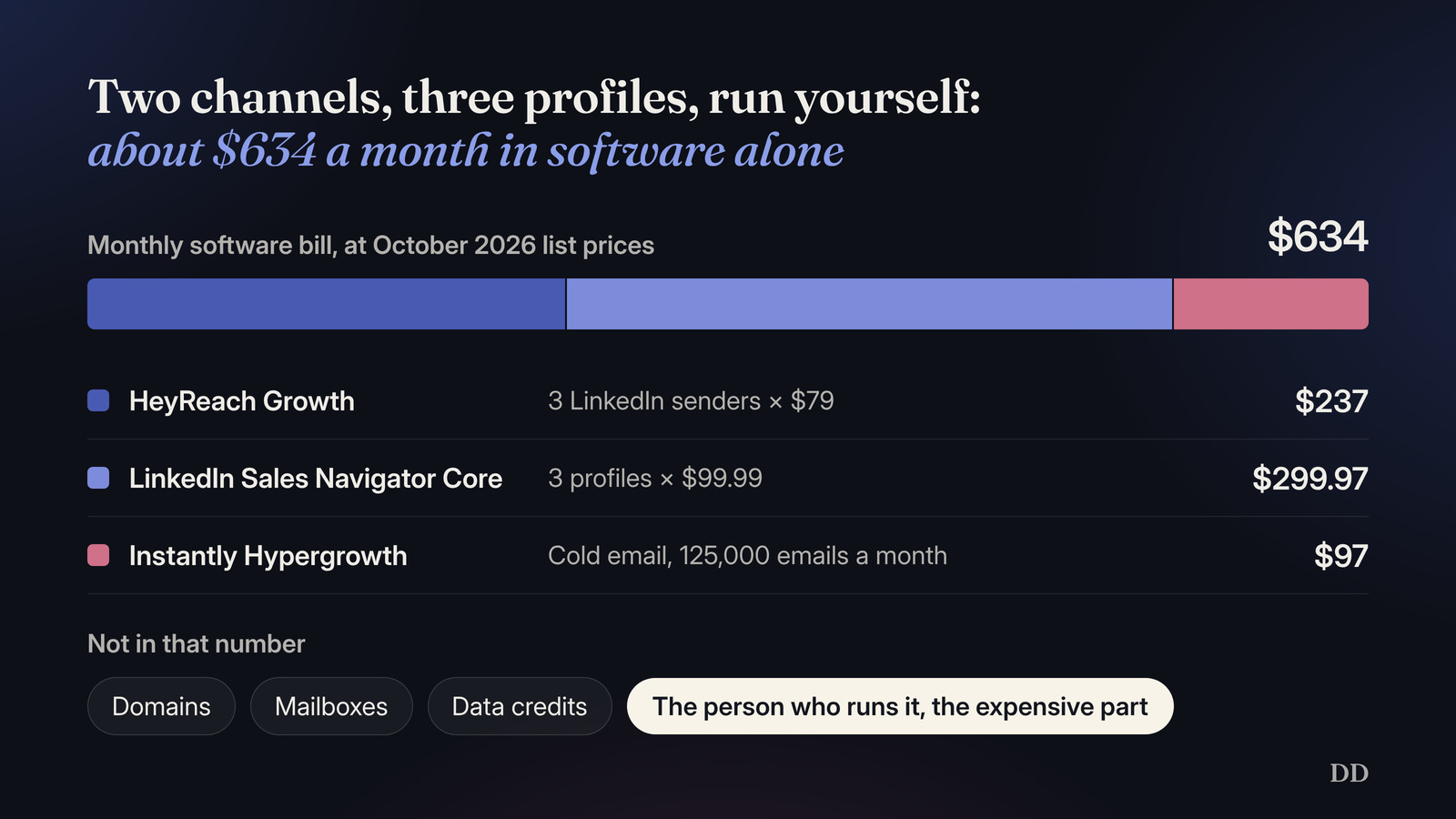
Then add the person who builds the list, writes for both channels, answers replies within hours and keeps one suppression file across two tools. That person is the expensive part. If you’re weighing the tools themselves, our breakdowns of Instantly vs Smartlead, HeyReach vs Expandi and the best LinkedIn automation tools cover them in detail.
Whatever you buy, ask each agency which of these costs sit inside the retainer, and whose name the accounts are in.
Who owns the domains and the LinkedIn profiles
Two ownership questions decide what you keep when an engagement ends.
The domains. Cold email should go out from separate domains registered in your name, never from your primary domain. LeadHaste registers domains and inboxes in the client’s name from day one, and Growth Rhino says you keep the domains, sequences and dashboards. Ask every agency for the name on the registrar account.
The LinkedIn profiles. You’ll see three models. Your own profile is the first (SalesBread, Cleverly and OutreachBloom all say so, and it’s how we run it too, from your profile or your team’s). SalesBread also adds your colleagues’ profiles for volume. Some agencies send from profiles they provide.
Your own profile carries your network and your history, which is why a request from it gets accepted, and your content lives there too. It also means the agency needs access to it. Ask how they log in, whether they need your password, and what happens if LinkedIn restricts the account.
If the agency runs your LinkedIn content as well, check that it’s posting from the same profiles that send the outreach. That’s the whole point of buying both.
How to choose: a decision map
Find your situation, then look at the first pick, and the second if the first says no.
Both channels as one sequence, with content from the same profiles: The Demand Department, then Workflows.io.
A Clay-built data layer under the outbound: ColdIQ, then SalesCaptain.
A printed price and a meeting floor: LeadHaste, then SalesCaptain.
Contracts above $50,000, and calls move deals: Growth Rhino, then Belkins.
An SDR team selling into several regions: Martal Group, then Belkins.
Phone and chat in the same campaign: Sopro, then Belkins.
A LinkedIn-only start on a small budget: Cleverly, then SalesBread.
Hand-written LinkedIn, month to month: SalesBread, then Cleverly.
Nine questions for the first call
Every agency here will take the call. The answers to these separate one sequence from two campaigns.
1. What happens to a positive email reply inside the LinkedIn sequence? Good: it stops the LinkedIn steps the same day and lands on one CRM record. Bad: “our team keeps an eye on it.”
2. Is the person who emails the same person who sends the connection request? Good: yes, the same name and the same offer. Bad: two different senders.
3. Is there one suppression list across both channels? Good: one file, updated daily, covering customers, open deals and every no. Bad: two lists in two tools.
4. Whose name are the domains and mailboxes registered in? Good: yours. Bad: “we handle all that.”
5. How do you access my LinkedIn profile? Good: a clear method, and a plan if LinkedIn restricts the account. Bad: “just send us your password.”
6. What counts as a lead, and what counts as a meeting? Good: a written definition with qualification criteria. Bad: any reply counts.
7. Which costs sit outside the retainer? Good: a line item for each tool. Bad: “it depends on volume.”
8. What does the first month look like, week by week? Good: dates for the lead list, the LinkedIn launch and the first email send. Bad: “about four to six weeks.”
9. What happens to everything when we leave? Good: you keep the domains, mailboxes, lists, sequences and CRM history. Bad: a long pause before the answer.
Frequently asked questions
- Is it better to run cold email and LinkedIn together?
- Yes, when they run as one sequence. A buyer who sees your name in the inbox and then in LinkedIn notifications recognizes you the second time, and a reply on either channel tells the other one what to do next. Run as two separate campaigns, the same buyer gets pitched twice by tools that don’t know about each other.
- How much does a cold email and LinkedIn outreach agency cost in 2026?
- LinkedIn-only productized services start around $300 to $1,000 a month. Two channels run by a small managed team usually cost $2,000 to $5,000 a month. Outbound on a data and engineering build runs $3,000 to $10,000, and SDR teams with calling run from about $3,800 to $12,000 or more. Tools such as Sales Navigator, LinkedIn sending seats and email sending platforms often sit on top.
- How long until an agency books meetings?
- Plan on a quarter. Cold email domains need about two to three weeks of warm-up before they send, LinkedIn can start sooner, and sequences need a few cycles of replies before they’re tuned. At The Demand Department, LinkedIn goes live in week two and cold email in week three. Cleverly says its LinkedIn campaigns gain momentum over three to four months, and Prospeo’s review of Sopro mentions a 60 to 90 day ramp.
- Should LinkedIn outreach run from my profile or the agency’s?
- Your own profile, or your team’s. Your network and your history are what make a connection request worth accepting, and content posted from the same profile does the warming. The trade-off is access, so agree how the agency logs in and what happens if the account gets restricted.
- Can I run cold email and LinkedIn myself with Instantly and HeyReach?
- Yes. The software is cheap: three Sales Navigator Core seats, three HeyReach senders and Instantly’s Hypergrowth plan come to about $634 a month at current list prices. The work is the expensive part: building the list, writing for both channels, answering replies within hours and keeping one suppression list across two tools.
- What’s the difference between multichannel and omnichannel outbound?
- Agencies use the two words interchangeably. The difference that matters is coordination, meaning whether a buyer’s action on one channel changes the next step on the other. Ask for that, whatever the agency calls it.
- Do I need LinkedIn content as well as outreach?
- If your buyers are on LinkedIn, it helps the outreach convert. A buyer who accepts your request often looks at your profile before replying, and posts about the problem your email raised do work a follow-up can’t. Write those posts for the buyers in your sequence rather than for reach.
One question to take into every call
Every agency on this list will tell you its channels work together. Twenty minutes into the first call, ask what happens to a positive email reply inside the LinkedIn sequence, and notice how long the answer takes.
If you want to hear ours, the 30-minute strategy session ends with a number: how many meetings the system can book for you, channel by channel, from your volumes. Or start with 100 leads scored against your ICP, free, in 24 hours.
Three layers, run as one revenue system
This article is one piece of the system we build and operate for our clients. See how the three layers are wired together, read the case studies, or start with how it works.
- Cold Email Outbound — sending infrastructure, verified data, and sequences that book qualified calls.
- LinkedIn Outbound + Content — connection sequences and founder led content run from one profile.
- Paid Advertising — account based campaigns and retargeting on the accounts you already work.
Related articles
- The best cold email agencies of 2026, ranked by what happens after the reply — Nine cold email agencies ranked on what happens after a prospect replies: who answers, how fast, where the meeting lands, and what each one costs.
- What a Cold Email Agency for Agencies Should Deliver — Learn how to define the operational scope of an outbound partner. Focus on domain setup, list building, and copy rather than bloated agency services.
- Pricing Models for a Cold Email Agency for Agencies — Compare outbound pricing tiers to select the right partner. Learn how execution models vary across standard retainers and performance deals.
- The Best Cold Email Platform 2026: Tested Rankings — An operator evaluation of cold outbound software built on real client campaigns. Compare real costs, infrastructure limits, and deliverability performance.